


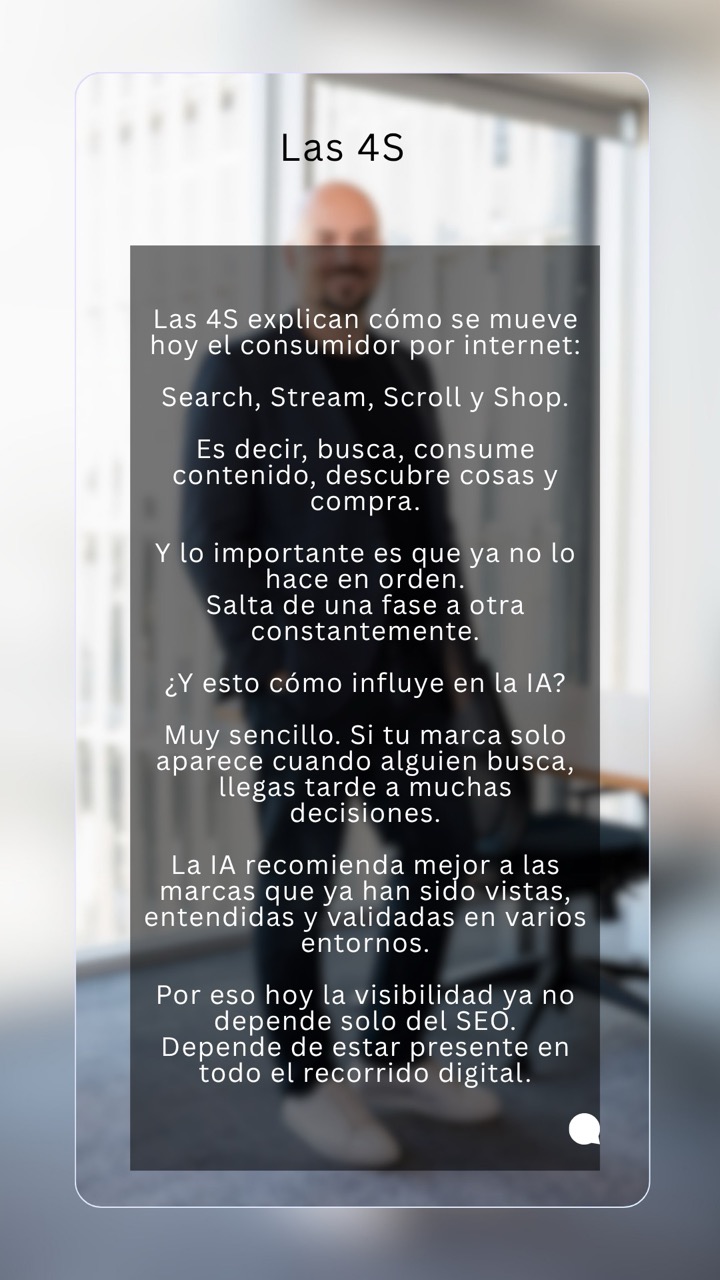
The 4S of today’s consumer offer a much more precise way to understand how people move around the internet today. Search, stream, scroll, and shop describe four behaviors that constantly overlap throughout the digital journey.
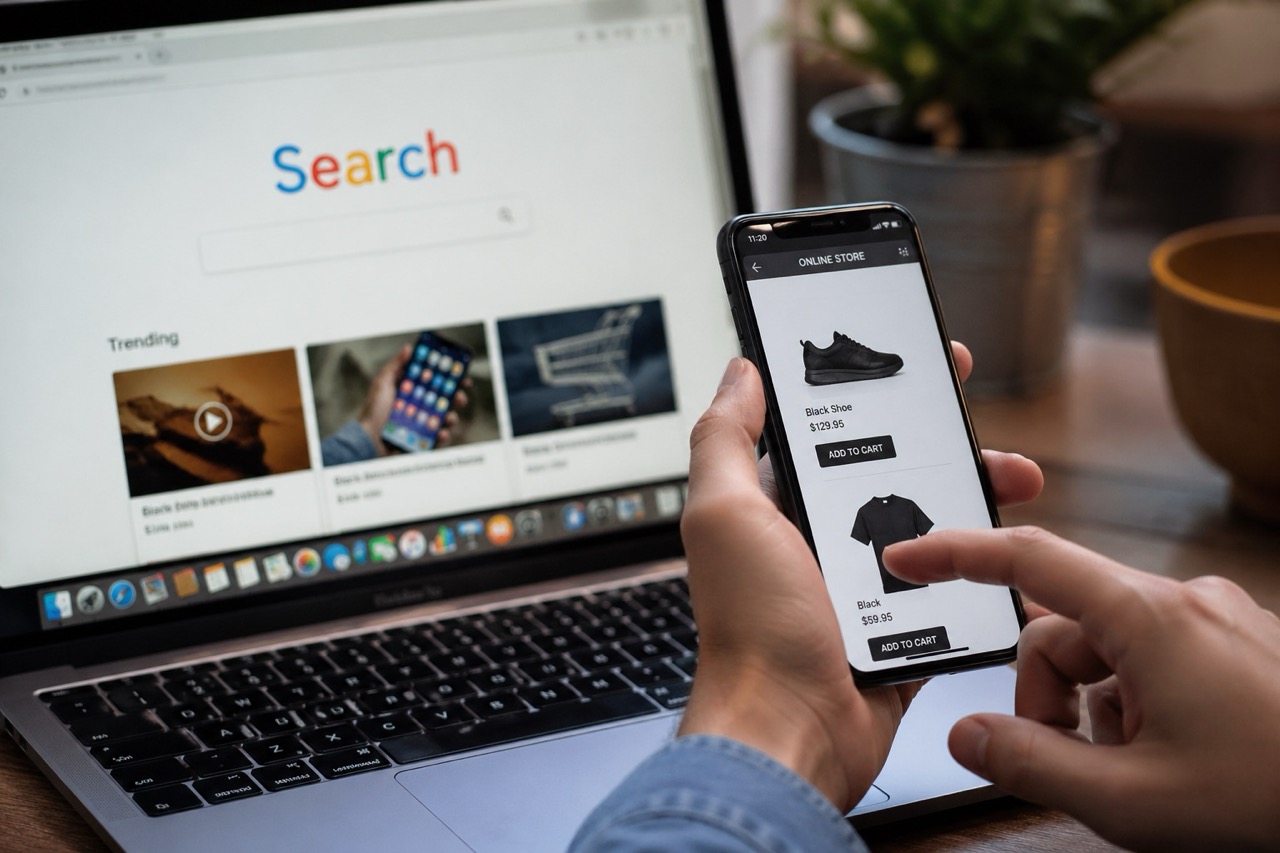
A user may search for an answer on Google, move to YouTube to expand the information, discover a brand while scrolling on Instagram or TikTok, and end up comparing options before buying. That movement does not follow a straight line, nor does it respond to the classic funnel that was taught in marketing for years.
For a brand, understanding this logic means working on visibility, content, and commercial positioning with more intelligence. From the perspective of an SEO consultant and a GEO consultant, this framework is especially useful because it helps explain why a user may discover you in one channel, trust you in another, and choose you in a third.
The 4S of today’s consumer and their impact on SEO, GEO and digital visibility
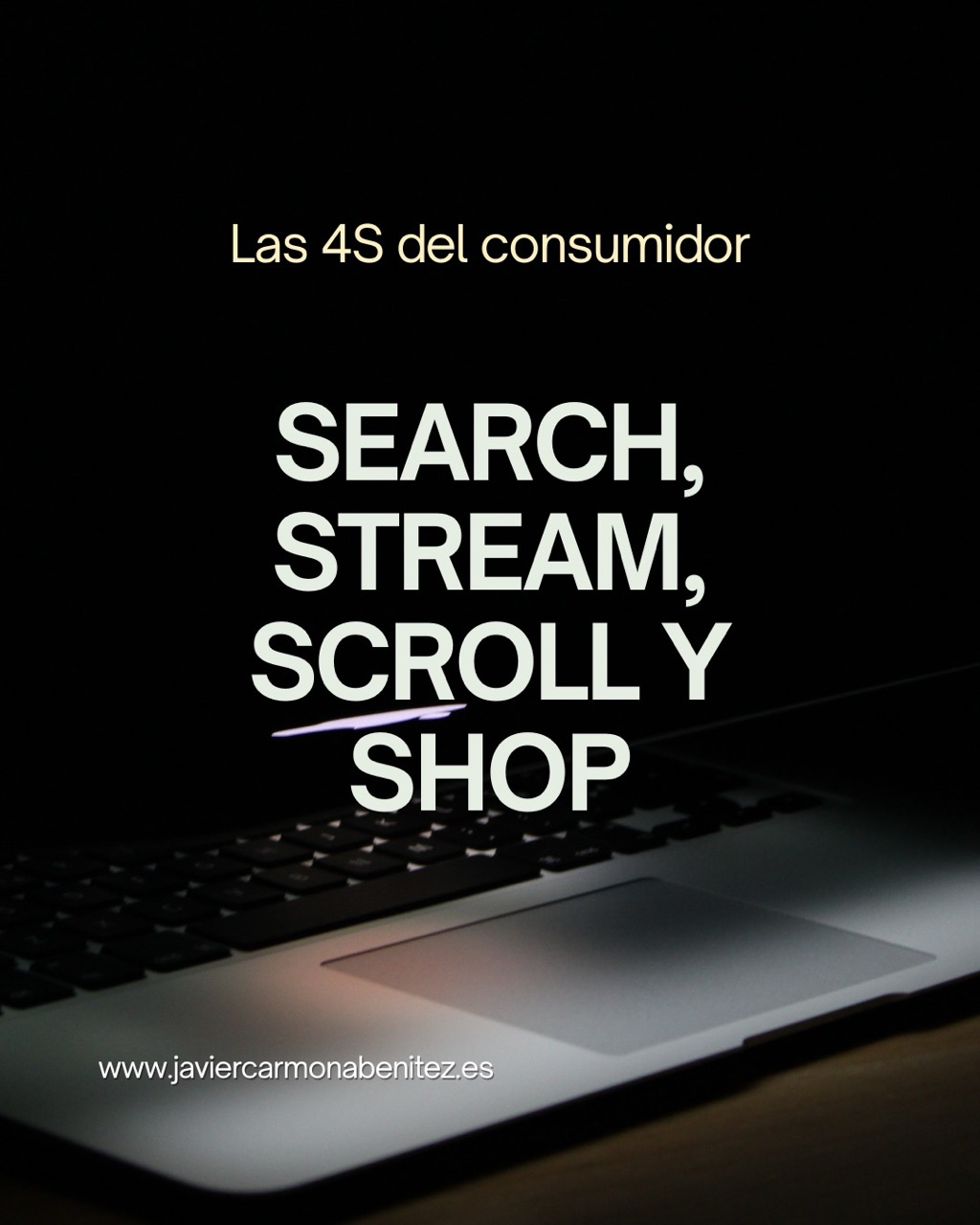
The 4S summarize four behavioral states that coexist within the digital environment. Search represents intentional search, stream represents sustained content consumption, scroll represents continuous discovery inside feeds and platforms, and shop represents the moment when the commercial decision gets closer or materializes.
What makes this model interesting is not only the four words, but what they reveal about real user behavior. People no longer move through the internet in a linear or orderly pattern. They jump between screens, mix formats, compare sources, and make decisions at moments that previously seemed secondary.
This reading changes many things in marketing. It forces us to move beyond the idea that everything begins and ends with a classic search. It also forces us to rethink how we measure visibility. A brand may have a well-positioned article and still lose attention if it does not exist in video, on social media, or in environments where users discover ideas without actively looking for them. In the same way, a company may achieve a lot of reach on social media and convert nothing if it is not properly prepared for the search or purchase moment.
In SEO and GEO, this has a very clear practical translation. Positioning remains decisive, but it can no longer be understood in isolation. The user needs to find consistent signals at different points of the journey. When they search, they want clarity. When they consume content, they want depth. When they scroll, they respond to quick and memorable stimuli. When they enter the purchase phase, they demand trust, proof, ease, and consistency. The 4S help organize that complexity.
Search and the value of appearing with intent
Search is the dimension closest to classic SEO, but it is not limited to Google in the traditional sense. Searches on YouTube, marketplaces, social networks, and even artificial intelligence interfaces also belong here. Search describes the moment when a person formulates a query with a more or less clear degree of intent. They may be solving a doubt, comparing options, looking for a definition, or trying to decide whom to hire.
This behavior remains enormously important because search is still one of the moments with the highest commercial quality. The user expresses a need, and that need can be interpreted. The job of a brand is to respond well, not just to appear. Ranking is of little use if the content does not answer the query clearly, if the value proposition is vague, or if the page does not convey trust.
From a positioning perspective, Search requires semantic precision, structure, authority, and the ability to answer. From the user’s perspective, it requires immediate understanding. An idea I have repeated in other pieces fits well here: clarity gains ground because it reduces friction. In search, that advantage multiplies. Whoever explains better solves better. Whoever solves better usually sustains visibility better.
A legal firm, for example, may receive traffic for searches such as “property purchase lawyer Costa Blanca”, but that visit will only have value if the page makes clear what service it provides, who it helps, and why it generates trust. A clinic may appear for “dental implants Alicante”, but the search will not convert by itself. It needs clear content, reviews, signs of experience, and a well-articulated proposal. Search does not simply reward presence. It rewards well-executed relevance.
Stream and the construction of trust through content
Stream represents sustained content consumption. This includes YouTube, podcasts, connected TV, long-form video, live sessions, and other formats where the user spends more time listening, watching, or following an explanation. This behavior has enormous value because it allows a brand to develop context, transmit judgment, and build a deeper relationship with the audience.
In stream, immediacy and the click are not the only things that matter. The ability to hold attention and create a perception of authority matters more. A professional who explains well on video, a channel that develops ideas with rigor, or a brand that produces useful content in this environment achieves something that is very hard to buy with advertising: quality time and brand memory. In many projects, that depth becomes one of the factors that most strengthens trust before contact or purchase.
Many mature commercial decisions are born or consolidated here. The user may first search for a general concept, but it is in stream where they expand information, understand nuances, and begin to assess whether a brand really knows what it is talking about. That process does not always end in an immediate conversion, but it does strengthen the ground on which the decision will later be made.
For a serious content strategy, stream plays a central role. It allows you to go deeper where a short post or a product page cannot. It also makes it possible to repurpose a core idea into more complete formats, which fits very well with a content architecture designed for several channels. A short tip can open the topic, but a long video or a developed blog piece turns it into a stronger reference.
Scroll and the discovery that activates new needs
Scroll describes one of the most common behaviors in the digital environment. The user does not always enter a social network, a feed, or a platform with a specific purchase or research intent. Many times, they are simply browsing. Even so, that apparently passive gesture has enormous strategic relevance because many discovery opportunities are born there.
In scroll, the brand appears before a formal search exists. A short video, a clear idea, a visual example, or a well-formulated observation can spark interest where there was no explicit question yet. This changes the way visibility is understood. It is not enough to wait for the user to formulate a query. Very often, the brand must enter that person’s mental conversation earlier.
The logic of scroll does not invalidate SEO. It complements it. A brand may be discovered on Instagram or TikTok, validated later on Google, and compared afterwards on the website. The opposite may also happen. The important thing is to understand that attention no longer comes only from declared intent. It also comes from encountering a strong idea at the right moment.
Creativity, message clarity, and visible identity matter a lot here. A profile without its own voice easily becomes interchangeable. Confusing content disappears in seconds. By contrast, a short, direct piece with a recognizable angle can fix an idea in the user’s mind even if they are not ready to buy yet. Scroll is a territory of attention and memory, not only vanity metrics.
Shop and the moment when intent becomes action
Shop represents the environment where the user approaches purchase or hiring with a clearly commercial logic. This includes product pages, comparisons, marketplaces, service pages, catalogues, bookings, forms, and experiences designed to facilitate the final step. Shop is not only the transaction. It is also the moment when the proposal must prove that it is ready to close the decision.
At this stage, trust stops being an abstract concept and becomes operational. The user needs verifiable signals, clear information, easy contact, concrete arguments, and an absence of friction. A brand may have done search, stream, and scroll well, but if it arrives weak at shop, the journey breaks. That is why consistency between the 4S is so important.
In ecommerce, this is very evident. A poor product page, a vague description, or a lack of reviews can break the impulse. In services, the same thing happens, although it is sometimes less visible. A weak landing page, a vague proposal, or a poorly planned form greatly weakens the closing stage. Shop requires synthesis, proof, and commercial architecture. Seeing well-presented success stories helps much more than it may seem at that final moment of the journey.
GEO work also comes into play strongly here. In local businesses, the purchase or contact often does not happen only on the website. It may materialize from a local profile, a call, a route, or an action started inside Google’s own environment. This reality connects with phenomena we have already discussed, such as zero click, and forces us to measure with a broader perspective.
How the 4S mix in the real user journey
The strength of this model lies in the fact that it does not present four separate compartments. It presents four behaviors that overlap. A user may discover an idea while scrolling, search for more specific information on Google, expand context on YouTube, and end up buying days later from a local profile or a service landing page. Another user may begin with a technical search, mentally save the brand, encounter it again on social media, and close the decision later. The paths change, but the mix is the norm.
This forces us to abandon the obsession with attributing everything to a single point. Many brands still read their marketing as if each channel had to justify the conversion by itself. That view falls short. The 4S show that one part of the work consists of planting, another of explaining, another of sustaining memory, and another of facilitating action. When those layers are understood as a system, the analysis improves and so does the strategy.
For a local business or a specialized professional, this reading can make a major difference. A user may first see you on Instagram, then search for your name on Google, check your profile, visit the website, and decide after reading an article or watching a video. If you only look at the last click, you understand little. If you observe the journey as a system of signals, you understand much more.
What a brand should do to adapt to this model
Adapting to the 4S does not mean being everywhere without criteria. It means designing a coherent presence at the points of the journey that truly matter for your business. First, you need to know where people discover your brand, where they validate you, where they compare you, and where they finally act. From there, the strategy becomes more precise.
In search, it is advisable to work on useful content and pages prepared to respond clearly. In stream, it is useful to develop pieces that allow explanation and depth. In scroll, it is important to build short messages with identity and focus. In shop, it is necessary to reduce friction, strengthen trust, and make action easier. Each environment requires a different language, but all of them must support the same brand proposal.
Coherence becomes central again here. A brand that presents itself one way on the website, another way on social media, and another way in its local profile makes it much harder for both the user and the search engine to interpret it. A brand that maintains a clear line, even while adapting the format, builds a more stable perception. And that stability matters for both SEO and GEO.
It is also worth reviewing measurement. Traffic still matters, but it does not explain the whole reality. Current visibility includes impressions, mentions, brand searches, profile interactions, calls, routes, video views, and decisions formed within the digital ecosystem itself. The 4S help us understand precisely that value no longer always appears in a single classic data point.

The opinion of an SEO and GEO expert
The 4S of today’s consumer seem to me a very useful way to read the internet without outdated simplifications. Search, stream, scroll, and shop describe how a real person behaves today better than many theoretical funnels that are still circulating. The user mixes channels, formats, and decision moments. A brand that understands this has a major advantage over one that still expects a clean and perfectly ordered journey.
My reading is clear. Digital visibility is no longer won only when someone searches on Google with purchase intent. It is also won when a brand knows how to appear properly while the user consumes content, discovers new ideas, or validates references. That is why SEO, GEO, content, video, local profiles, and brand building should not be treated as isolated pieces. They are part of the same system. If you want to see that professional presence in a local environment, you can find me on Google Maps.
A company that takes this logic seriously will communicate better, measure more intelligently, and have more options to occupy a recognizable place in the user’s mind. That is the true value of understanding the 4S. It is not about memorizing four English words, but about accepting that the digital journey already works as a mixed ecosystem and that the brand needs to be ready to move naturally within it.
fusion_global=”17304″]
Analyse your website or your competitors’ websites with this SEO tool:
“Together we can improve the Present and Future of your Online Business”
Javier Carmona Benítez



Leave a Reply
You must be logged in to post a comment.