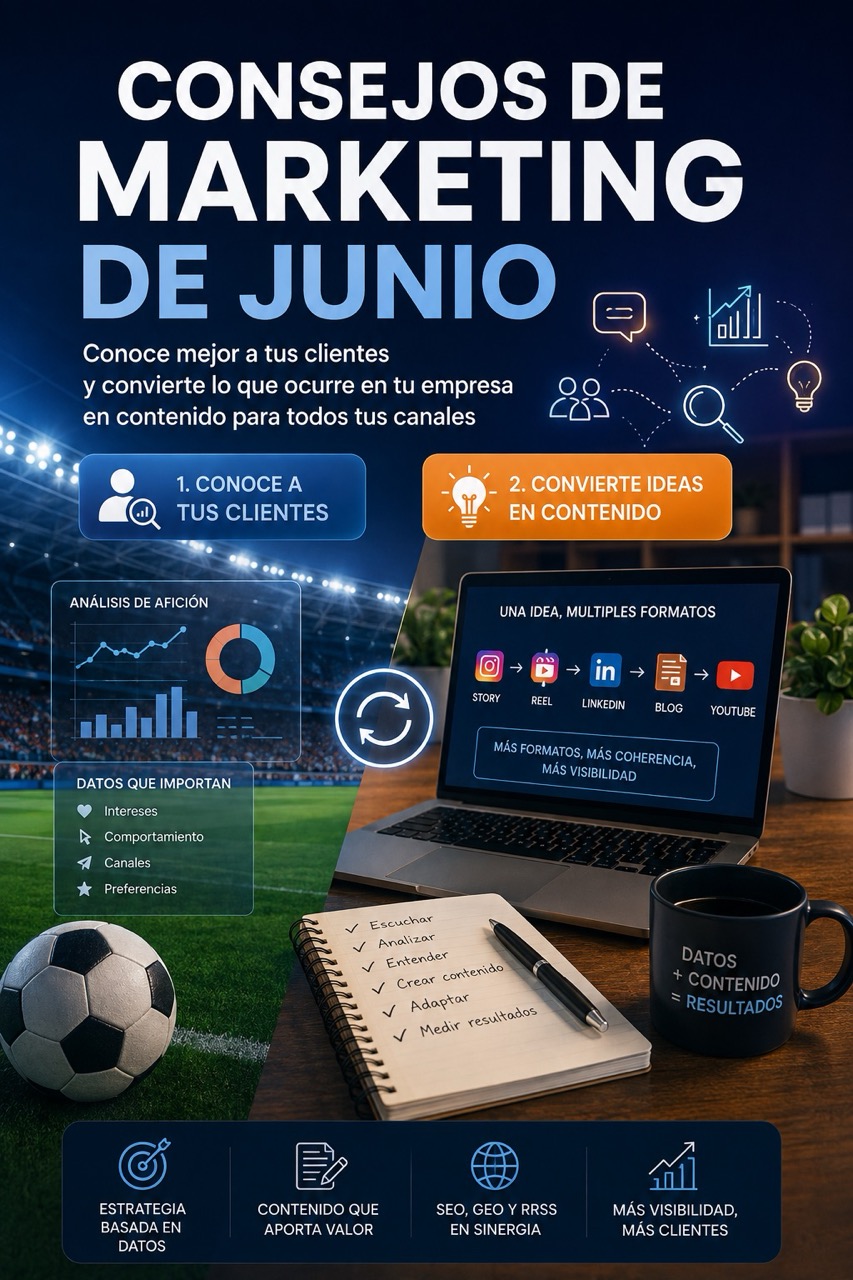
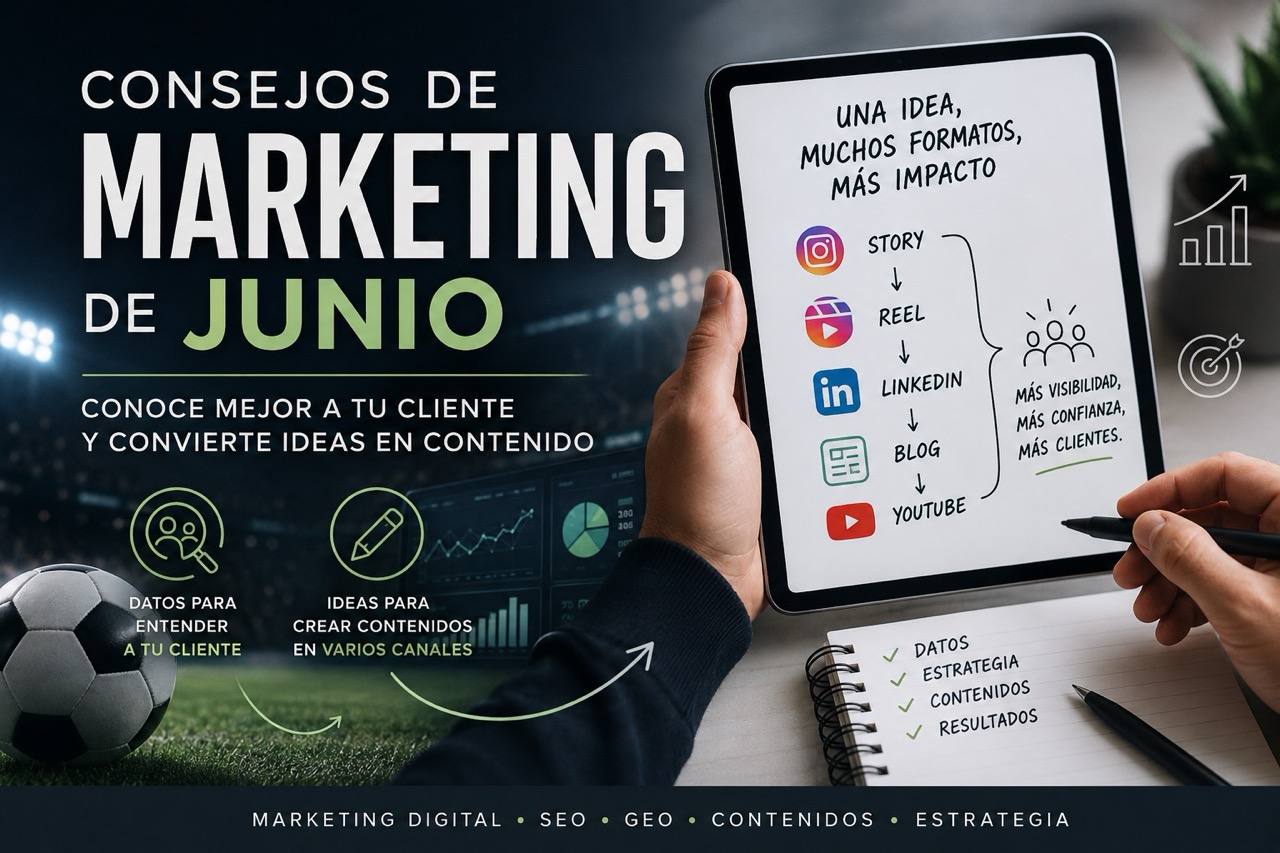
During June I continued sharing tips on digital marketing, SEO, content and strategy on Instagram. This time I selected two ideas that, although they come from very different situations, are much more closely connected than they may initially seem: getting to know our customers better through data and making better use of everything that happens inside a company to generate content.
Both tips come from everyday situations. The first arose from football and the way major clubs and sports brands study their fan bases. The second comes from something I constantly see among companies and professionals: experiences, customer questions, projects, reflections and knowledge can all be transformed into content for different channels.
Both ideas share the same way of understanding marketing. First, we need to know more about the people we want to reach. From that knowledge, we can decide what to communicate, which formats to use, where to publish and which messages have the best chance of connecting with our audience.
That will be the central theme of these June marketing tips: making better use of the information generated by a business and then turning that knowledge into a more coherent content strategy.
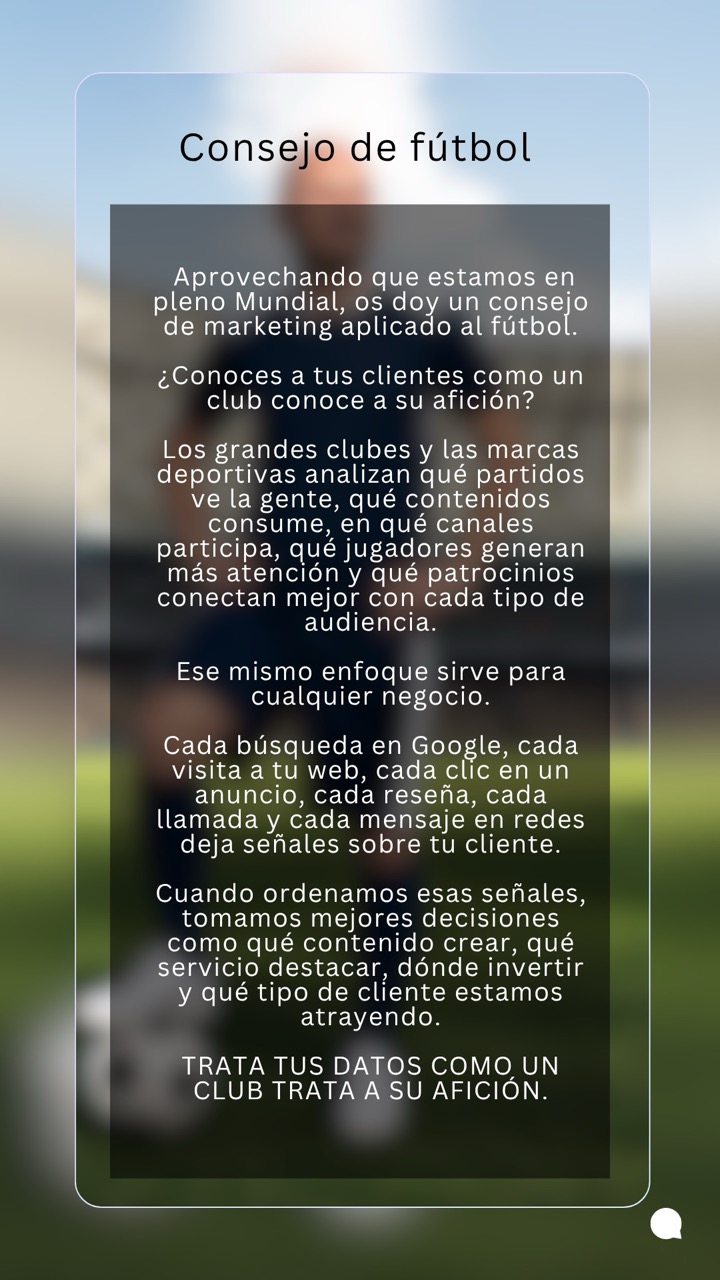
Football offers a very visual example of something that any company can apply to its marketing strategy. Major clubs know their supporters increasingly well and continuously study their behaviour.
They analyse which matches generate the most interest, which content performs best, where their fans participate, which players attract the most attention and which commercial actions connect better with different audiences. All of this information helps them understand the people who make up their community.
Accumulating information has little value if it does not influence decisions afterwards. The interesting part begins when a brand uses that data to decide what content to develop, how to present a launch, which player may connect best with a particular segment or which channel deserves more investment for a campaign.
The same principle works in practically any business. A company can analyse the signals left by its customers and turn them into useful information to improve its marketing and commercial strategy.
That was precisely the question I used to introduce this tip. Every company continuously generates signals about its customers, although those signals are often spread across different tools, platforms and conversations.
Google, the website, advertising, social media, phone calls and sales themselves all provide small pieces of information. The challenge is to connect them in order to understand more clearly what a person is looking for and how they interact with our business.
A Google search can tell us what need someone is trying to solve. Visiting a particular page on a website reveals interest in a specific service. Clicking on an ad shows which message managed to capture their attention.
The signals continue outside the website. A sales call can reveal recurring questions, a review shows which aspects of the service a customer values most, and comments or messages on social media can help uncover new interests and objections.
Individually, these may seem like small pieces of data. When we connect them, we gain a much more complete picture of our audience.
This approach is closely related to the concept of a Buyer Persona and how it is applied to digital marketing. Knowing the customer means understanding their needs, motivations, behaviour, problems and real data. The better we define that context, the easier it becomes to build a coherent strategy.
One of the clearest applications appears in content planning. Imagine a company that repeatedly receives the same three questions before a customer hires a service. Those questions are already showing what information a potential customer needs.
From there, we can create articles, videos, LinkedIn posts, reels, FAQs or commercial content. The behaviour of the audience itself begins to guide the editorial calendar.
Something similar happens with SEO. From an SEO agency, we analyse what users search for, which terms they use, which pages generate traffic and which queries bring them closer to a conversion.
That information helps us prioritise content and identify which topics genuinely respond to an existing intent. Data becomes valuable when it turns into a concrete decision: what content to create, which service to promote, which message to reformulate, where to invest or what kind of customer we are attracting.
All of this makes even more sense when SEO, advertising, content and analytics are treated as parts of the same strategy. On my digital marketing services page, I explain how we connect different areas to improve a company’s visibility and customer acquisition.
The advantage of working across these disciplines together is that each channel provides information about the others. A campaign may uncover interesting search terms, SEO can reveal new customer needs, and content can turn that knowledge into pieces capable of attracting new customers.
The website is one of the places where we can collect the most signals. We can study which pages receive the most visits, which channels users arrive from, what content they view, how they navigate through the site and which actions they ultimately take.
That journey helps identify pages that perform particularly well and others that need improvement. It also helps us understand which content moves users closer to an enquiry, a phone call or a request for information.
Analytics tools such as Google Analytics help organise part of this data. I previously explained some of the essential Google Analytics 4 reports and how they can help us understand how users interact with a website.
This information can be complemented with Google Search Console, advertising campaigns, CRM data, phone calls, forms, sales and real conversations with customers. Each source answers different questions and, together, they allow us to build a much more complete view of the customer journey.
The final goal is to make decisions with greater context. If a service receives many visits but generates very few enquiries, it is worth analysing what is happening. If another piece of content attracts users who later visit several commercial pages, we have a different signal.
Recurring questions can also highlight opportunities. When the same doubts appear before someone hires a service, our website may need more information, specific content may be required or the commercial message may need to be explained more clearly.
The way people discover companies, products and services is evolving. Google remains fundamental, but ChatGPT, Gemini, Copilot, Perplexity and other artificial intelligence systems have now joined the process.
Understanding the customer therefore also means paying attention to the places where they search for information. Some people arrive through a traditional Google search, others discover a company through social media and others begin by asking an artificial intelligence system directly.
These changes broaden the customer’s digital journey. The same person may discover a brand on Instagram, search for its name on Google, visit several pages on its website and then use ChatGPT to compare potential providers.
Each touchpoint can influence the final perception of the company. That is why it is increasingly important to maintain clear, consistent and sufficiently detailed information across the entire digital presence.
The work of a GEO agency also starts from this need: ensuring that a company’s information is understandable, relevant and sufficiently robust to appear in new search and recommendation environments powered by artificial intelligence.
SEO and GEO share an essential idea here. Before creating content, we need to understand what the person is looking for, what they need to know and what information can help them move forward in their decision.
The phrase I used to close this first tip summarises the idea quite well: treat your data the way a club treats its fans.
Clubs know the interests of their supporters because that information allows them to communicate with them more effectively. Any company can apply the same reasoning to its customers and turn every interaction into a small clue about the market.
An SME can learn a great deal simply by collecting the questions it receives, reviewing which pages generate the most enquiries, observing which posts trigger responses and analysing which services attract the most interest.
Connecting those signals is more important than accumulating hundreds of metrics. An isolated data point describes something that has happened; interpreted correctly, it helps decide what to do next.
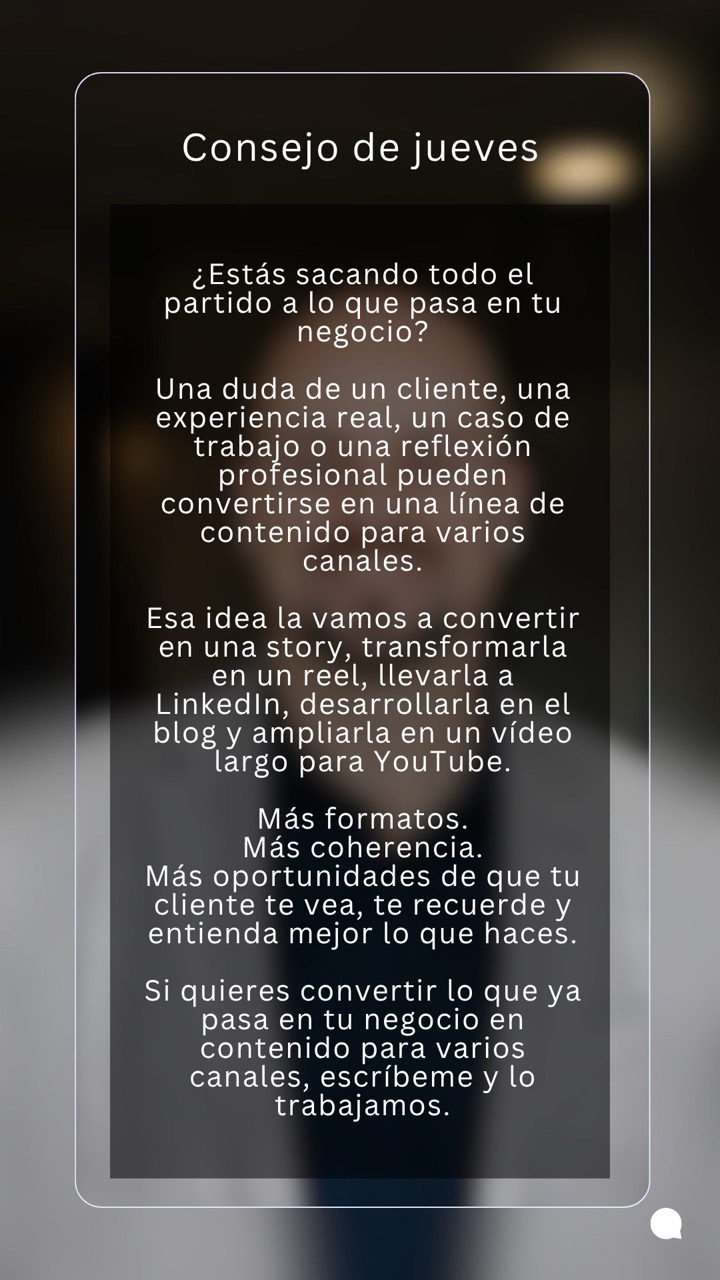
The second tip starts precisely from everything above. When we listen to our customers and pay attention to what happens inside a company, content ideas begin to appear constantly.
Many businesses have a huge amount of knowledge that never becomes communication. Questions, meetings, real cases, lessons learned and problems solved can provide an excellent starting point.
A customer’s question can become an article. A real experience can become a post on LinkedIn. A solved problem can become a case study, and a professional reflection can work perfectly as a story.
Even the explanations we repeat frequently during meetings or calls can become videos. Very often, the content already exists as knowledge, conversation or experience. The task is to identify it, organise it and adapt it.
In the story, I suggested a very simple journey. An idea can first appear as a short post, then become a reel, be developed further on LinkedIn, expanded on the blog and eventually become a longer YouTube video.
The core remains the same, but the format changes depending on the channel and the point at which we want to reach the user.
A story needs to be direct and quick. A reel allows us to add image, voice and rhythm. LinkedIn gives us space to develop a professional reflection, while the blog allows us to go deeper, structure the information using headings, work on related searches and build internal links.
YouTube offers another possibility: explaining longer processes, using visual examples and developing topics that need several minutes to be properly understood. Each channel serves a different function within a common strategy.
Reusing an idea works better when we understand the characteristics of each platform. Publishing exactly the same text across five channels makes very little use of what each one can offer.
We can keep the main concept and adapt the depth, format, opening, examples or call to action. The story sparks interest, the reel summarises a concept, the article adds depth, the video can explain a process and LinkedIn can open a professional conversation.
This gives us more formats, greater consistency and more opportunities for customers to see us, remember us and understand more clearly what we do.
This way of working also connects with something I have been explaining on the blog for years: a good content creation strategy for websites needs to start from a topic and develop it in an organised way. The same subject can generate different pieces as long as each one adds something and fulfils a specific purpose.
Social media has enormous potential for distributing content and creating contact with an audience. The blog performs a different function because it gives us our own space where an idea can be developed without depending on the duration of a reel, the limited space of a story or the speed of a feed.
In addition, each article can rank in search engines, receive internal links from other pages and continue generating visits long after publication.
While a social media post usually concentrates much of its reach in the first few hours or days, a well-optimised article can continue appearing in searches for months or even years.
In my article on SEO for blogs and content marketing, I explain in more detail the relationship between content creation, rankings and organic visibility.
That is why I like using the tips I publish on social media as a starting point for this series. The story is short and has a specific purpose: introducing an idea quickly.
The blog can then expand that reflection, introduce examples, connect it with previous content and build a much more complete piece around it.
One of the best sources is in front of us every day: real customer questions. When several people ask the same thing, there is probably an information need worth addressing.
That question can become an FAQ section, an article, a social media post, a video or even an improvement within a commercial page.
Working from real questions keeps the strategy connected with the market. Instead of continually imagining what might be interesting, we use conversations that are already happening.
The same applies to real cases. A strategy developed for a client can explain a process, a common mistake can become educational content and an industry update can lead to a professional reflection.
Projects also allow us to show how these ideas are applied outside theory. In my digital marketing, SEO and web design portfolio, you can see some of the work I have developed and how a digital strategy changes according to the needs of each company.
Showing real examples helps people understand the work behind disciplines such as SEO, web design, digital advertising and content strategy.
Content reuse also makes sense from a visibility perspective. An interesting idea can become a social post and, at the same time, be developed as a page capable of answering a specific Google search.
That same content can also provide sufficiently clear and specialised information for artificial intelligence systems to understand a topic, company or service more accurately.
Developing a topic in depth allows us to add context, examples, experience, relationships with other concepts and links to pages that expand the information.
In this way, we build an ecosystem in which the website, blog, social media, video, SEO and GEO stop functioning as completely separate activities.
Someone may discover me through a post on LinkedIn, then visit the blog, review the agency services and later search for me on Google.
Another person may start directly from an organic search. Someone else may arrive after watching several videos or pieces of content on social media. The journeys vary, but the brand needs to maintain a recognisable line across all of them.
Publishing across several channels can seem like it multiplies the workload. Good planning can achieve the opposite: making much better use of every idea.
The change comes from stopping thinking about each platform in isolation and starting instead with concepts that are strong enough to be developed later in different formats.
If every Monday we need to invent five different topics for five platforms, the process can quickly become exhausting. Starting from a single strong idea simplifies planning considerably.
For example, a real question can become the central piece of the week. We can answer it in a story, make a short video with the main point, write a professional reflection on LinkedIn, develop the explanation on the blog and use the article as the basis for a longer video.
Each format provides a different perspective and all of them reinforce the same message. That continuity allows a company to become progressively associated with particular topics and areas of expertise.
Consistency also builds brand positioning. When a company talks regularly about what it genuinely works on, the audience gradually understands more clearly what it does, what it knows and how it can help.
The two June tips ultimately meet at precisely this point. The first is about data and customer knowledge; the second is about transforming experiences and information into content.
The order makes sense: first we listen and observe. Then we use what we have learned to communicate in a more relevant way.
Searches, visits, clicks, phone calls, messages, questions and reviews help us understand what interests the audience. That knowledge can be used to decide which topics to develop, which examples to use and which services need a more complete explanation.
It also helps determine which content is worth adapting to different channels. The editorial strategy therefore stops depending entirely on inspiration and begins to draw from real information coming from customers, projects and digital behaviour.
This approach can be applied inside a company as well. Sales, customer service, marketing and management teams are constantly in contact with information that can become new communication opportunities.
On my SEO, SEM and digital marketing training page, I bring together courses and workshops designed precisely to apply these tools to the real work of professionals and companies.
These two June tips summarise quite well how I currently understand a digital marketing strategy. We have more channels, more tools and more data than ever. That makes it especially important to connect them and use them with a clear objective.
Data is especially useful when it helps us understand people better. Knowing what they search for, which pages they visit, what questions they ask and which content interests them allows us to make decisions with greater judgement.
I like the football example because it is very easy to visualise. A club studies its supporters to understand them and communicate with them more effectively. A company can apply exactly the same logic to its customers.
You do not need millions of followers or enormous databases. Listening to incoming questions, reviewing website behaviour and analysing which content generates interest already provides a considerable amount of information.
Then comes communication. I believe many companies have much more material available than they imagine. Things happen every day that can become content: questions, projects, lessons learned, solved problems, meetings, market changes, results and professional reflections.
The key is identifying those opportunities and knowing how to transform them. Some will work as a story, others deserve a reel, certain ideas will fit better on LinkedIn and others will need a complete article.
Some ideas can grow even further and become videos, case studies or new pages on the website. For me, that is one of the key ideas: more formats can also mean greater consistency when they all come from the same strategy.
SEO, GEO, social media, analytics, content and branding do not need to move along separate paths. They can all be fed by the same questions: who is our customer, what do they need, what are they searching for, what can we offer them and what is the best way to explain it?
When we can answer those questions well, every piece of data and every business experience can become an opportunity to communicate more effectively.
If you want to apply this approach to your company and work on a strategy adapted to your business, you can contact me and tell me about your project.
My experience with local ChatGPT Work and Work Cloud: files, browsers, autonomy and context in SEO, website migrations and development… Leer más
Leave a Comment