The SEO, SEM and AI news from this first week of October 2026 brings several changes that already have practical consequences for those of us working in search visibility, digital advertising, analytics and artificial intelligence strategies. Google is continuing to roll out its spam update, has updated its guidance on AI-generated content and has just removed one of the long-standing settings used in Search campaigns: manual language targeting.
There are also important developments in Google Ads, Microsoft Advertising, Google Analytics and ChatGPT Ads. Some of them justify reviewing campaigns almost immediately. Others do not yet warrant a change in strategy, but they help us understand how search and digital advertising are evolving.
This article continues my analysis of the SEO, SEM and AI news from the final week of September. The approach will remain the same every week: explain what has changed, identify what can genuinely affect a business and separate the decisions worth making from the usual noise surrounding every development related to Google or artificial intelligence.
These are the fifteen developments I consider most relevant between 28 September and 5 October 2026.
Update |
Area |
Impact |
|---|---|---|
| September 2026 Spam Update remains active | SEO | Ranking movements should not yet be interpreted as final. |
| Google updates its guidance on AI-generated content | SEO / AI | It reinforces accuracy, quality, relevance and added value. |
| Effort, Originality, Talent/Skill and Accuracy gain prominence | SEO / Content | A useful framework for auditing both human and AI-generated content. |
| AI Overviews grow in branded searches | SEO / GEO | Brand reputation is increasingly shaped inside generative answers as well. |
| Google Ads removes manual language targeting from Search | SEM | Google now interprets language automatically using ads and other signals. |
| Google relaxes business name requirements in ads | Google Ads | Some brands will be able to use a business name that differs from the domain. |
| Google clarifies Destination not working errors | Google Ads | AdsBot access, HTTP 200 responses and technical configuration become essential checks. |
| Google may charge for certain missed calls in Local Services Ads | Local SEM | Answering the phone correctly can have a direct impact on lead costs. |
| Microsoft removes Max CPC from certain new automated campaigns | Microsoft Ads | Less manual control within some bidding strategies. |
| Microsoft opens Optimization Experiments | Microsoft Ads | Changes can be tested through experiments before being applied fully. |
| Microsoft Advertising integrates with HubSpot | SEM / CRM | Advertising, commercial opportunities and revenue become more closely connected. |
| GA4 expands app conversion analysis | Analytics | Cross-channel attribution between apps and other channels improves. |
| ChatGPT Ads introduces configurable attribution windows | AI / Advertising | Reported results can change depending on the attribution model selected. |
| OpenAI develops advertising campaigns based on product feeds | ChatGPT Ads | Ecommerce businesses can work directly with product catalogues. |
| ChatGPT introduces virtual try-on and Favourites | AI / Ecommerce | More stages of the consideration process can take place inside the assistant itself. |
The first genuinely important piece of news is not new, but it remains fully relevant. The September 2026 Spam Update began on 24 September and, at the time of publishing this article, Google still lists it as active.
The Google Search Status Dashboard states that the update affects all languages globally and that the rollout may take up to two weeks.
This means we are still within a period in which rankings may move without giving us a stable picture of the final outcome.
If a website has lost rankings, I would analyse which directories, content types, queries or page templates are experiencing the decline. I would also compare competitors and look for patterns involving scaled content, low-value pages, artificial links or other elements that could conflict with Google’s spam policies.
What I would not do is change dozens of pages simply because a graph has fallen for several days. We first need to distinguish between a temporary fluctuation during the rollout and a sufficiently stable change that genuinely justifies intervention.
On 1 October, Google recorded an important update in its Search Central documentation concerning the use of generative artificial intelligence.
This is not a new penalty against AI-generated content. Google’s position remains fairly consistent: using artificial intelligence is not inherently a problem; using it to produce content at scale without adding value may fall within its policies against scaled content abuse.
The change can be reviewed in Google’s official Search documentation updates.
It is particularly interesting that Google has made four concepts from its Quality Rater Guidelines more visible: effort, originality, talent or skill, and accuracy.
Google gives the automated generation of large volumes of AI content without sufficient supervision or curation as an example of low effort. At the opposite end are original analysis, first-hand experience, editorial work and anything that contributes information that cannot simply be found repeated in exactly the same form across hundreds of other pages.
Google’s documentation on creating helpful, reliable, people-first content now develops these four criteria more clearly.
I think they can be used as a fairly sensible framework for reviewing content. Not because they are four new independent ranking factors, which Google has not claimed, but because they allow us to ask useful questions.
This fits very well with the evolution I recently discussed in my article about how search visibility has evolved from traditional SEO towards GEO. When a machine can produce reasonably competent text in seconds, simply publishing more words stops being a competitive advantage.
Another particularly interesting SEO development comes from third-party data, so it needs to be interpreted more cautiously.
DemandSphere reported on 1 October that the percentage of branded keywords in its sample triggering an AI Overview increased from 26.12% on 1 September to 82.06% on 29 September, reaching as high as 90.48% on 27 September.
The DemandSphere study on AI Overviews and branded searches uses monitored terms across different markets and devices. Google has also not officially announced any specific rollout associated with this increase.
I would not use that percentage to claim that eight out of ten branded searches in Spain now necessarily generate an AI Overview.
What matters is the trend.
Until now, branded searches were one of the more controllable areas of SEO. When someone searched directly for a company, they would normally find its website, Business Profile, social networks, directories and other related results.
If Google begins placing a generative answer above those results, part of how a company is perceived will also depend on how Google builds that response and which sources it chooses to use.
This makes brand monitoring increasingly similar to GEO. It is no longer enough to ask whether our website ranks first. We also need to understand what Google says about us, what information it uses and whether that information accurately represents our activity.
This is probably the most operational SEM change of the week.
Since the end of September, Google has been removing campaign-level language targeting from Search and AI Max for Search. In Performance Max, the configured language is no longer used for the Google Search portion of the campaign, although it continues to apply to other channels such as YouTube, Display, Discover and Gmail.
Google explains the change in its documentation on the new automatic language management in Google Ads.
The platform will use the language of the ads, the user’s query, user preferences and other signals to determine which creative should be shown.
In simple campaigns, the change may go largely unnoticed. International accounts or campaigns operating across several languages deserve much closer attention.
If we previously separated campaigns into Spanish, English, French or German, we now need to make sure that ads, keywords, landing pages and campaign structure provide sufficiently clear signals for Google to understand which version should be used.
It is another move towards an advertising environment where we configure fewer explicit rules and provide more context to the system. For those of us who manage Google Ads and digital advertising campaigns, supervision is becoming just as important as the initial campaign setup.
Google has also published several less spectacular but highly practical changes for day-to-day campaign management.
During October, Google will update its editorial policy to allow, under certain circumstances, the business name displayed in an ad to differ from the destination domain.
The name must accurately represent a recognised brand belonging to the advertiser, there must be a verified direct relationship between the advertiser and the domain owner, and the corresponding products or services must be sold directly on that website.
The official business name policy update excludes affiliates, independent intermediaries and certain resellers.
Google has also provided more detail about the reasons that can cause a Destination not working rejection.
The landing page must return an HTTP 200 response and be globally accessible to Google AdsBot. A firewall, CDN, security configuration, incorrect redirect or bot-specific block can cause the destination to be rejected even when the page appears to work perfectly when we open it ourselves.
Google’s official documentation on Google Ads destination requirements also adds an interesting detail: a campaign without any asset groups may show an invalid final URL error even when the destination itself works correctly.
Since 1 October, Google has also expanded the circumstances in which a call from its local advertising and pay-per-lead system may be considered chargeable.
An unanswered call during business hours can become a valid lead when the user remains on the line for more than 20 seconds. Certain subsequent calls may also become chargeable when the initial interaction did not previously meet the required criteria.
The practical consequence is straightforward: for a local business, managing the phone properly no longer affects only the commercial ability to convert an enquiry. It can directly affect acquisition costs as well.
For companies working on local SEO and Google Business visibility, it makes increasingly little sense to analyse rankings, advertising, the Business Profile, opening hours and customer service processes as separate areas. They all ultimately contribute to the real experience of the person trying to contact the business.
Microsoft is moving in a direction that is increasingly similar to Google in search advertising.
Since 1 October, a Max CPC can no longer be set when creating new non-portfolio campaigns using certain automated strategies, including Maximize Conversions with Target CPA, Maximize Conversion Value with Target ROAS, or Maximize Clicks.
Existing campaigns that already use such a limit can retain it, while portfolio strategies continue to offer the option.
Microsoft explains the change within its update on AI Max and bidding automation.
Microsoft Advertising has also opened its Optimization Experiments for Search, Shopping, Audience and Performance Max.
This makes it possible to test bidding, targeting, creative assets and other changes using treatment and control groups before applying them fully.
The direct integration with HubSpot also adds an interesting layer for B2B projects: campaigns, contacts, commercial opportunities and revenue can be connected within a workflow that is closer to the actual sale.
Both developments form part of the September Microsoft Advertising update.
On 29 September, Google Analytics introduced more complete support for app conversions within its cross-channel reporting.
Conversions generated through apps can now be used in performance reports, attribution analysis and attribution models. Google also allows certain attribution settings to be configured independently for those conversions.
Google acknowledges that the feature may not yet be available across every property, but the direction is clear.
The full update can be reviewed in the Google Analytics release notes.
For projects combining websites and applications, having a more consistent cross-channel view helps reduce one of the usual analytics problems: treating each environment as though the customer always begins and completes the journey within the same device or platform.
OpenAI continues to add functionality to ChatGPT Ads, and some of these changes are becoming considerably more interesting than the simple existence of advertising inside the assistant.
OpenAI currently allows advertisers to select 7, 14 or 30-day post-click windows and to activate or deactivate a one-day view-through conversion window.
The change may appear small, but it directly affects the interpretation of results.
Two reports covering exactly the same period may display different conversion totals simply because they use different attribution windows. Before comparing campaigns or months, we therefore need to know exactly which methodology is being used.
OpenAI explains how this works in its documentation on measuring ChatGPT Ads results.
OpenAI is also developing campaigns based directly on product catalogues.
An ecommerce business can provide a feed containing information such as product name, price, image, description, availability and URL, which can then be used to build ads from the catalogue.
The documentation on ChatGPT Ads Product Feeds shows how quickly the system is beginning to resemble a complete advertising platform rather than a simple experimental format.
Ads Manager also already provides self-service access for legal entities established in Spain.
For ecommerce, this connects perfectly with something we have been seeing for months: feeds, structured data and catalogue quality are becoming simultaneously useful for advertising, search engines and generative systems.
On 1 October, ChatGPT also introduced new Shopping features.
For clothing and accessories, users may see an option to virtually try on a product using their own photograph. Products can also be saved as Favourites and organised into folders.
OpenAI lists these developments in the ChatGPT release notes.
From a marketing perspective, the most interesting aspect is not simply the virtual fitting experience. Every new comparison, selection or saving feature allows a larger part of the purchase consideration process to take place inside the assistant before the user visits the store.
This is another reason to understand GEO and visibility within artificial intelligence systems as an additional layer of digital strategy rather than an isolated replacement for SEO.
Of everything analysed above, there are five actions that I consider clear enough to apply to real projects.
I would analyse movements and preserve the data, but I would avoid large-scale changes while Google continues to report that the update is still active.
The removal of manual language targeting makes it worthwhile to review campaign structure, ads and landing pages in any account operating across several markets or languages.
This is particularly relevant for websites where AI plays an intensive role in editorial production. Automating content creation cannot also mean automating the absence of review, experience or originality.
Opening hours, call forwarding, switchboards, automated messages and the actual ability to answer calls can directly affect lead costs.
I would not turn the DemandSphere figures into a general alarm, but I would include branded queries in GEO monitoring: company name, brand plus service, reviews, prices and other high-intent searches.
If I had to summarise what has happened this week, I think there are two particularly important developments, and they are closely related.
The first is that platforms are progressively removing manual controls. Google decides the language of an ad, Microsoft reduces certain CPC limits, and advertising systems increasingly use artificial intelligence to select queries, creative assets, audiences and destinations.
The second is that, at exactly the same time, Google is emphasising effort, originality, skill and accuracy when discussing content.
I do not see this as a contradiction.
Machines can carry out more and more tasks, but that moves professional value somewhere else. We no longer need to prove that we are capable of manually changing hundreds of bids or writing thirty almost identical versions of the same text.
We need to understand the objective we are pursuing, what information we provide to the system, which limits should exist and how we determine whether automated decisions actually make sense for the business.
This applies to both SEM and SEO.
If an AI system generates content, someone needs to determine whether that content contributes anything, whether it is correct and whether it reflects genuine experience.
If Google Ads automatically decides the language, query or landing page, someone needs to check whether it is taking the right user to the right destination.
If ChatGPT uses a catalogue to display products, we need to make sure that prices, images, attributes, stock and landing pages are structured correctly.
Automating a task does not remove the need for judgement. In many cases, it increases it.
I also find the increasing appearance of AI Overviews for brand-related queries particularly significant.
For years, we have worked on digital reputation by focusing on our website, Google Business, reviews, media coverage, directories and social networks. If a generative answer starts appearing between the query and those results, all of that external information becomes even more important.
A generative system needs to determine who you are, what you do and which sources it considers sufficiently reliable to talk about you.
This is where SEO, reputation and GEO begin to overlap very clearly.
I think this is the common idea behind almost every development this week.
Campaigns need business data. Content needs experience and accuracy. Assistants use catalogues. Google generates answers about brands. Analytics tries to connect conversions across channels. The Business Profile can even define elements that influence how certain advertising calls are handled.
This is why it makes less and less sense to approach each discipline as an isolated area.
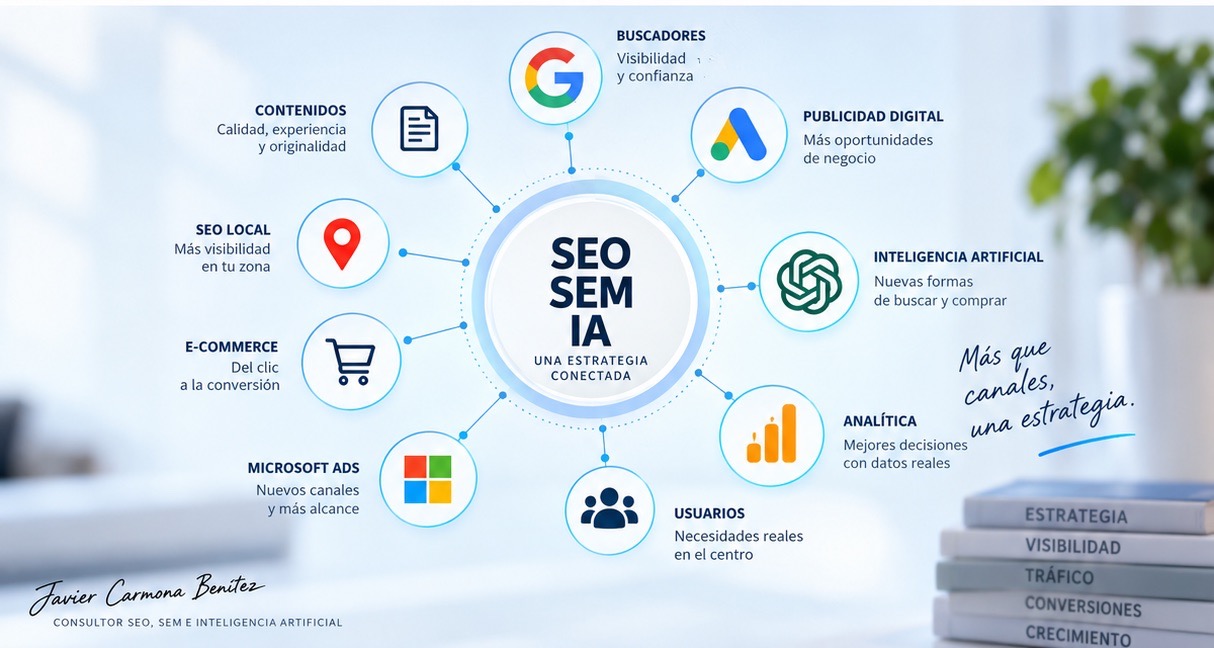
In my work as an SEO, SEM and artificial intelligence consultant, I try precisely to connect these different layers. The ultimate objective remains the same: making a company visible when there is a genuine need, ensuring that visibility reaches the right person and being able to measure whether it ultimately turns into business.
You can also view my professional profile on Google Maps, where you will find information about my activity, location and client reviews.
The tools will continue to change. Within a week, we will have new features and probably new acronyms. What matters is not confusing novelty with strategy. Some changes are worth applying immediately, while others only need to be monitored. Knowing how to distinguish between the two remains a fundamental part of the job.
My experience with local ChatGPT Work and Work Cloud: files, browsers, autonomy and context in SEO, website migrations and development… Leer más

Leave a Comment