Choosing between the ChatGPT models in 2026 has become considerably more complicated than it was a few years ago. We no longer simply have a new version replacing the previous one. Names such as Sol, Luna, Terra and Astra now appear alongside different reasoning levels and, in addition, different models depending on whether we are using Chat, Work or Codex.
The problem is that someone can open ChatGPT looking for a simple answer and suddenly find Instant, Medium, High, Pro, Sol or Astra without being entirely sure what actually changes between them. It does not help that OpenAI updates its model catalogue frequently and that some models are rolled out progressively depending on the plan or account type.
In this guide, I am going to organise the current ChatGPT landscape as of October 2026. The aim is not to compare benchmarks for the sake of it, but to understand which model makes sense for an everyday question, which one is better for professional work, when it is worth activating more reasoning and in which situations using Astra makes sense.
The first important point is that ChatGPT no longer has one identical model catalogue everywhere. OpenAI distinguishes between the conversational Chat experience, the more autonomous Work environment and Codex, which is mainly designed for software development and technical tasks.
This means that two users can both talk about “Sol” while actually using different versions. In Chat, the main model for paid plans is currently GPT-5.6 Sol. In Work and Codex, GPT-6 family models are already available, including GPT-6.1 Sol, GPT-6 Sol and GPT-6 Luna, while GPT-6 Astra sits at the top in terms of capability.
The exact availability depends on the plan, each workspace configuration and OpenAI’s progressive rollout. This is why two accounts may not display exactly the same options on the same day.
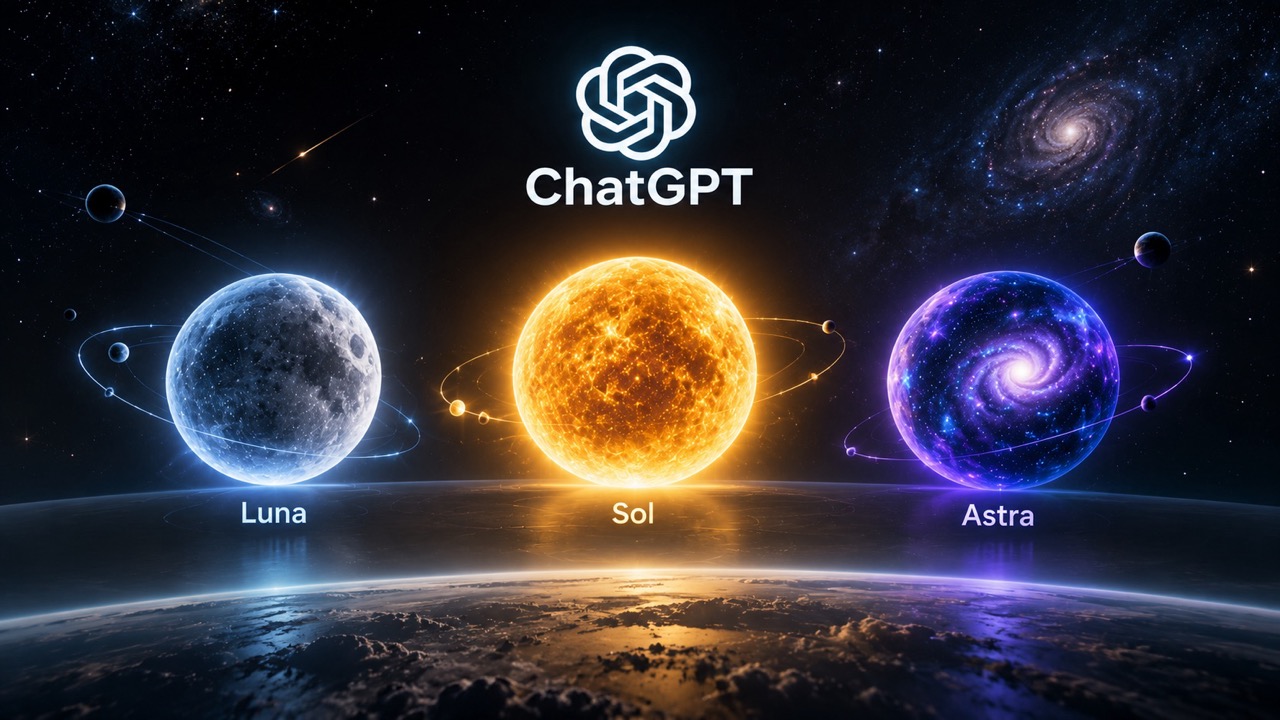
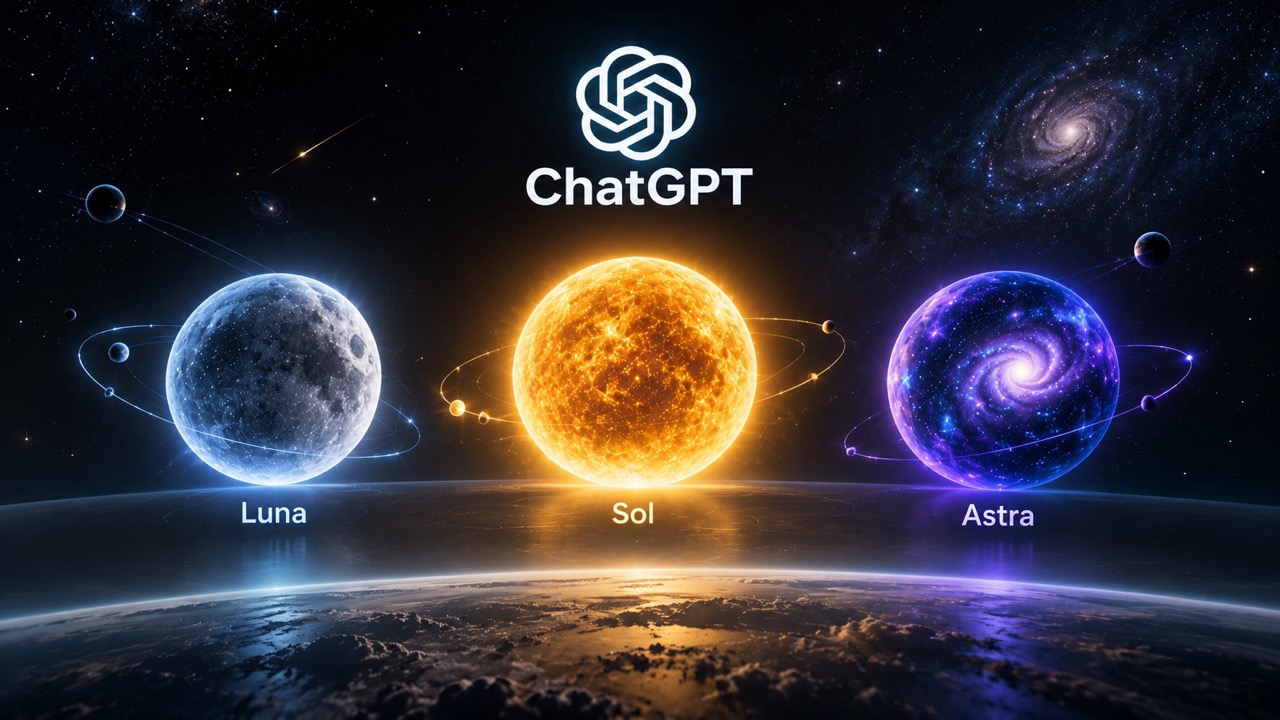
If we remove some of the noise, there are currently five names that help explain almost the entire range.
GPT-6.1 Sol should also be added to this list. It is particularly important in Work and Codex because it comes close to Astra’s performance in many complex tasks while consuming fewer resources.
An overly simplistic interpretation would be to assume that Luna is bad, Terra is average, Sol is good and Astra is excellent. The reality is considerably more interesting.
OpenAI is segmenting its models according to a combination of intelligence, speed, computational cost and type of work. A smaller model can be far more suitable for classifying thousands of items than a much more powerful one. In the same way, using Astra to correct a three-line sentence would be a waste of capability.
GPT-5.6 Luna is currently the model powering the default ChatGPT experience for Free and Go users. OpenAI describes it as the fastest and most efficient option in the GPT-5.6 family.
That does not mean it is only useful for basic questions. Luna can search for information, analyse files, work with images and handle many everyday queries. Users on free plans can also activate the Think function to dedicate more reasoning to difficult problems.
In professional environments, Luna is particularly interesting for repetitive tasks, information extraction, data classification, small modifications or work where speed is the main priority.
Terra sits between Luna and Sol. OpenAI positions it as a balance between capability, speed and cost for everyday work.
It is not the main model in the conventional Chat experience, although it may appear in Work, Codex and other environments. It makes sense when we need more capability than Luna but do not want to dedicate Sol or Astra resources to every operation.
It can work well for routine analysis, simple report writing, document processing, content transformations or repeatable business tasks.
Sol is probably the name professional users most need to understand. GPT-5.6 Sol is designed for programming, research, knowledge work, science, analysis and complex professional tasks.
In ChatGPT, compatible paid plans use GPT-5.6 Sol with different reasoning levels. This allows us to keep the same model while deciding how much effort it should dedicate to each question.
For a large proportion of everyday professional work, Sol offers the most interesting balance. Writing, analysis, research, strategy, document interpretation, programming, marketing, planning and explaining complex concepts all fit comfortably within its capabilities.
Sol Pro takes the same family into more demanding tasks. OpenAI positions it for difficult problems and long workflows where allocating more resources to finding the answer is worthwhile.
This distinction matters because Pro should not be understood as the mode that should be used for absolutely everything. It makes sense when the cost of making a mistake is higher, the problem contains many variables or a superficial answer would not be sufficient.
Analysing a complex business situation, reviewing a technical architecture, studying a large amount of documentation or solving a difficult scientific problem are examples where it can provide additional value.
Astra currently represents the upper end of OpenAI’s capabilities. The company positions it particularly for computer use, web browsing, software engineering, research, science, cybersecurity and complex professional work.
It is also particularly well suited to multi-step tasks. It can work with information, use tools, navigate applications, organise materials and generate documents, spreadsheets or presentations.
In conventional Chat, it can appear under the name GPT-6 Pro on compatible plans. In Work and Codex, it is directly associated with GPT-6 Astra.
This naming difference causes quite a lot of confusion. GPT-6 Pro in Chat is powered by Astra. Astra is the underlying model, while GPT-6 Pro is the option users encounter within certain ChatGPT experiences and plans.
Another important model appears in Work: GPT-6.1 Sol. OpenAI presents it as a model capable of approaching Astra’s performance on complex work while maintaining lower cost and resource consumption.
This makes it particularly interesting for professionals. We do not always need to use the most powerful model available. Quite often, what we need is a model powerful enough to complete a task correctly while remaining efficient enough to use throughout the working day.
Astra retains a higher capability ceiling, particularly when a task requires extensive reasoning, research, computer use or solving unfamiliar situations.
GPT-6.1 Sol attempts to narrow that gap. It is designed for complex programming, computer use and professional work, providing what OpenAI describes as performance close to Astra at a lower cost.
For reports, document analysis, professional research, presentation preparation, business tasks or workflows involving several applications, GPT-6.1 Sol can become the logical default model within Work when it is available.
The Work and Codex model selector may also display GPT-6 Sol and GPT-6 Luna. GPT-6.1 Sol is a later evolution of Sol and is being rolled out progressively, so the exact combination of models may still vary depending on the account.
Models from the GPT-5.6 family may also remain available in certain workspaces during the transition. For this reason, it makes more sense to focus on the function of each model rather than memorising a fixed list that will probably change again.
The easiest way to organise all these options is to relate them directly to the type of task.
| Model | Profile | Recommended uses |
|---|---|---|
| Luna | Fast and efficient | Everyday questions, classification, extraction, small edits and repetitive tasks |
| Terra | Balanced for everyday work | Simple reports, document analysis, writing and routine business processes |
| Sol | High capability and good efficiency | Research, strategy, analysis, programming, content and professional work |
| GPT-6.1 Sol | Advanced professional work | Work, multi-step tasks, research, computer use, files, analysis and deliverables |
| Sol Pro | More computation within Sol | Very difficult problems, in-depth analysis and long-running workflows |
| Astra / GPT-6 Pro | Maximum capability | Complex research, advanced development, computer use, unfamiliar problems and critical professional work |
This is another change that causes considerable confusion. Choosing Sol or Astra determines which model we are using. Choosing Instant, Medium, High or Very High determines how much reasoning we allow that model to dedicate to the task.
They are two separate decisions.
A more powerful model using a moderate reasoning level can outperform a lower-tier model using a higher reasoning level. OpenAI’s own documentation provides a particularly significant example: Astra at Low effort can outperform Sol at High effort on certain tasks.
Instant is designed to respond quickly. It is appropriate for everyday questions, simple explanations, small corrections, brainstorming, quick searches or conversations where we do not need to solve a particularly complex problem.
On compatible paid plans, Instant uses GPT-5.6 Sol. On Free and Go, the experience is based on GPT-5.6 Luna.
Medium is usually a very reasonable choice when we need to analyse something in greater depth without moving straight to the maximum reasoning level.
It is particularly useful for analysis, research, planning, comparing alternatives, programming, strategy or professional problems involving several variables.
It is also a good starting point in Work. Using a powerful model with Medium reasoning will often provide a very good balance between quality, speed and resource consumption.
Higher levels make sense when the problem genuinely needs more analysis. Mathematics, complex programming, extensive research, planning with numerous constraints or decisions based on large amounts of documentation are reasonable examples.
Increasing reasoning does not automatically guarantee a better answer. If information, files, context or permissions are missing, allowing the model to think for longer will not solve that problem.
This is particularly important. Many weak answers do not need a better model. They need better instructions.
For the average user, the choice can be simplified considerably.
Free and Go users mainly work with GPT-5.6 Luna. For a more complicated question, they can activate Think, which allows the system to spend more time reasoning while still using Luna as the model.
Users on compatible paid plans use GPT-5.6 Sol as the main model. In this case, we can adjust the reasoning level according to the difficulty of the task.
A large proportion of queries do not need extended reasoning. General questions, explanations, writing, translation, ideas, text revision or quick queries work perfectly well with Instant.
Always using the maximum level can slow the process down without providing a proportional improvement.
When the request changes from “tell me something” to “analyse this”, increasing the reasoning level is worthwhile.
Comparing strategies, reviewing a contract, interpreting data, studying documentation, preparing a marketing strategy or analysing a technical problem are examples where Medium or High can provide a noticeable benefit.
Compatible plans can access GPT-6 Pro, powered by Astra. It makes sense when we want to raise the capability ceiling for a particularly complicated problem.
It should not automatically become the model used for every question. Its value appears when the complexity of the task justifies it.
The choice changes when we move from having a conversation to executing a piece of work. In my article about the differences between Chat and Work, I explain in greater detail when each environment makes sense.
Work is designed for longer tasks, multiple steps, files, connected applications and finished deliverables. Here, the intelligence of the model has a greater impact because we are not simply evaluating a single answer, but an entire process.
When GPT-6.1 Sol is available, it makes a great deal of sense to use it as the default option for a large proportion of professional tasks.
It can work with files, prepare reports, conduct research, analyse information, use tools, perform tasks on a computer and handle multi-step work without always paying the cost of using Astra.
A Medium reasoning level may be sufficient for a large proportion of these tasks.
Astra becomes particularly useful when a task combines several sources of difficulty: numerous sources, contradictory information, different tools, complex decisions, in-depth research or a deliverable where we need to maximise quality.
It also stands out when Work has to interact with applications and navigate interfaces. OpenAI has specifically trained Astra for computer use and professional work.
In these scenarios, starting with Astra at Medium reasoning is usually a sensible strategy. We can increase the reasoning level only when the difficulty genuinely justifies it.
Not everything we do in Work requires maximum intelligence. Extracting data from hundreds of records, classifying items, modifying small fragments or applying repetitive changes can be handled by more efficient models.
This is where Luna becomes useful. Saving resources on simple tasks allows us to reserve more powerful models for the moments when they really make a difference.
For writing articles, posts, emails, documentation or communication materials, GPT-5.6 Sol provides more than enough capability in most cases.
The quality of content depends much more on context, instructions, sources and revision than on automatically using the most powerful model available.
Sol works well for structuring information, adapting tone, rewriting, developing ideas or working with long-form content. Medium can be useful when the content requires research or a complex structure.
For professional content, it is also useful to provide previous examples so the model can understand the desired style. A good editorial reference will often contribute more than simply increasing the reasoning level to its maximum.
The situation changes when an article requires reviewing documentation, comparing sources, studying previous content, analysing a website and then producing a complete piece.
In that case, Work makes more sense because the task is no longer simply about writing. There is a research phase, an analysis phase and a production phase.
This separation is also important in SEO. The model can help with the content, but first we need to understand search intent, architecture and the relationship with the rest of the website. As an SEO consultant, I increasingly use artificial intelligence as a support layer within the process rather than simply as a text generator.
Research is one of the areas where the difference between models becomes much more noticeable. Writing well is not enough. We need to search for information, distinguish reliable sources, compare data, identify contradictions and build a coherent answer.
Sol with Medium or High reasoning can handle a great deal of conventional research. Astra becomes more interesting when the research is particularly complex or when Work needs to carry out a long and autonomous process.
The model and search are also different concepts. ChatGPT can access up-to-date information when a task requires it. In my guide on how ChatGPT searches the internet, I explain this aspect in greater detail.
A powerful model may reason better about sources, but it still needs access to the right sources. Likewise, an excellent search loses value if the information is then interpreted incorrectly.
The best results appear when we combine a good model, up-to-date search, reliable sources and clear instructions.
Marketing and SEO combine extremely different types of tasks. We can move from correcting one sentence to analysing a traffic decline, comparing campaigns, preparing an annual strategy or studying hundreds of Search Console queries.
GPT-5.6 Sol is perfectly suitable for copywriting, planning, metric analysis, data interpretation, content preparation, audience segmentation or research.
When the analysis becomes more complex, we can increase the reasoning level without necessarily changing the model.
If the task involves combining documents, Search Console, Analytics, campaigns, client information and historical data to prepare a report, we are clearly entering Work territory.
GPT-6.1 Sol provides a particularly interesting balance for this type of work because it can maintain a longer workflow and use tools without always relying on the most expensive model.
A complex audit may include contradictory data, market changes, dozens of pages, technical information and different commercial objectives. In this situation, Astra can provide additional value.
It can also be useful when we are working on issues related to visibility in artificial intelligence, where SEO, reputation, content, entities and external sources increasingly overlap. This is part of the work I currently carry out as a GEO agency.
Programming has its own environment within ChatGPT: Codex. Here we find a logic similar to Work, although it is specialised in software development and technical work.
GPT-6.1 Sol is particularly well suited to agentic programming and tasks where the model needs to maintain context, modify files, use tools and verify results.
Astra raises the capability ceiling when the problem is genuinely complicated, for example difficult debugging, unfamiliar architectures, security problems, large repositories or situations where research is required before modifying code.
Luna or Terra can still make sense for simple and repetitive modifications.
The evolution of ChatGPT is moving towards an idea that has existed in computing for decades: the right tool depends on the job.
Always using Astra would be similar to using a maximum-performance workstation to write a short note. It can do it perfectly well, but there is no proportional advantage.
OpenAI uses different quota systems depending on the model and product. Astra consumes the Work and Codex allocation more quickly than Sol or Luna.
Usage also does not depend solely on the number of messages. The size of files, the length of inputs and outputs, the reasoning level, the number of steps and the tools used all influence consumption.
For this reason, it makes more sense to optimise for completed tasks rather than for the model being used.
An incomplete instruction remains incomplete even if we use Astra. If we want to analyse a campaign and the model does not have access to the data, increasing the reasoning level will not allow it to correctly invent that data.
Defining the objective, context, sources, restrictions and expected format remains a fundamental part of working with artificial intelligence.
If some of these concepts feel too technical, I also have an Artificial Intelligence glossary where I explain the basic terminology in a simpler way.
After all this terminology, we can reduce the decision to a fairly simple logic.
This rule removes a large part of the confusion. First, we choose the tool according to the task. Then we decide how much reasoning it needs.
Less than a year ago, the conversation revolved around GPT-5.1 and GPT-5.2. In my previous comparison between GPT-5.2 and GPT-5.1, a clear trend was already emerging. Models were moving beyond improvements based purely on answer quality and becoming better at execution, tools, context and multi-step work.
The arrival of the Sol, Terra and Luna families, followed by GPT-6 Astra and GPT-6.1 Sol, consolidates that direction.
ChatGPT is evolving from an interface where we ask questions into a system where we select different levels of intelligence for different types of work.
The same logic is being transferred to the product itself. Chat focuses on conversation and solving questions. Work is designed to execute longer professional tasks. Codex specialises in programming.
Within each environment, we can choose the appropriate level of intelligence and reasoning. This is why it makes less and less sense to simply ask which version is “the best ChatGPT”.
The better question is which combination of environment, model and reasoning best solves the task in front of us.
My impression is that OpenAI is making the right decision by separating speed, intelligence and reasoning effort, although the terminology has become quite confusing for the average user.
For a long time, choosing a model basically meant using the latest version. In 2026, that logic is beginning to fall short. Luna, Terra, Sol and Astra respond to different needs, while the reasoning level adds a second layer to the decision.
In my professional use, Sol seems like the logical choice for most conversational work. It has more than enough capability to analyse, research, write and work through complex questions without constantly having to resort to the most powerful model.
The situation changes in Work. When I am working with data, different sources, files, applications and a final deliverable, models such as GPT-6.1 Sol or Astra make much more sense. For important tasks, Astra with Medium reasoning offers a particularly interesting balance. I would only use higher levels when the problem genuinely requires them.
I also believe this evolution changes the way we need to learn to use artificial intelligence. Knowing how to write prompts will continue to help, but it will become increasingly important to know how to break problems down, select sources, choose tools and decide how much intelligence each task actually deserves.
This change connects directly with the evolution we are seeing in digital marketing, SEO and GEO. The tools are becoming increasingly capable, but professional value still lies in knowing what problem we are trying to solve and how to turn all that capability into a useful result.
If you would like to learn more about my work or read client reviews, you can find me on Google Maps.
To prepare this guide, I reviewed official OpenAI documentation updated to October 2026 covering GPT-5.6, GPT-6 Astra, GPT-6.1 Sol, ChatGPT Work, Codex, reasoning levels and model availability.
My experience with local ChatGPT Work and Work Cloud: files, browsers, autonomy and context in SEO, website migrations and development… Leer más
Leave a Comment