Google has been sending out an email over the past few days that has caught the attention of users who have been using its products for years.
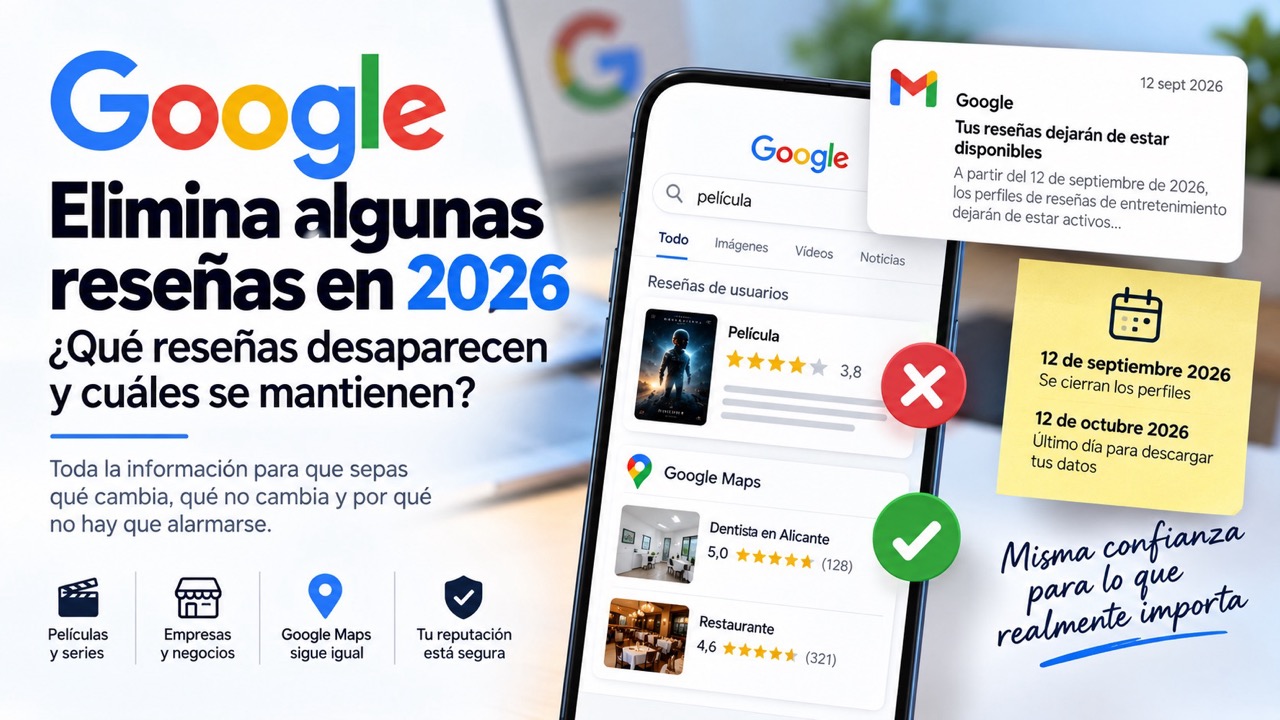
The message announces a change affecting certain reviews and profiles and sets October 12, 2026 as the deadline to download some data. The actual scope is quite specific: Google is shutting down a review feature linked to entertainment content within Search, especially movies, TV series and similar content.
For businesses, professionals and local companies, the key is to distinguish this feature from the reviews that are part of Google Maps and Google Business Profiles. They are different systems and serve different purposes. Below I explain what is disappearing, what remains, which dates matter and why this change is also relevant from the perspective of SEO, digital reputation and the evolution of search engines.
Google is removing the system used to manage certain entertainment content reviews in Search. For years, some search results related to movies, TV series and audiovisual content allowed users to publish a rating directly from Google Search.
These opinions could be associated with a profile created to collect and manage the user’s contributions. Google has now decided to shut down this feature as part of a broader simplification of the search results page.
The system was integrated into the search experience. A user could search for a movie, check information about it and, when the option was available, leave their own rating.
The review referred to the audiovisual content itself, rather than to a company related to it. For example, rating a movie was part of this entertainment system, whereas reviewing a cinema, store or locally listed platform belongs to a different Google environment.
Google could create a profile linked to these ratings to make them easier to manage. This explains why some users are receiving the email even if they barely remember using the feature.
A single rating left some time ago may have generated activity within this system. The current notice specifically informs users about the closure of those profiles and the deadline available to keep the associated data.
The message includes two different dates, and each one corresponds to a specific stage of the process.
On September 12, 2026, the profiles used to manage entertainment reviews in Google Search will stop being active.
This date marks the closure of the feature. Google is moving away from this experience within Search and removing the profiles that were used to collect these types of ratings.
On October 12, 2026, the deadline ends for downloading a copy of previous reviews and the data associated with those profiles.
Google provides Google Takeout for this purpose, its tool for exporting information linked to certain products in a Google account.
The October date is related to keeping a copy of the data. The system closes in September, and Google then provides an additional period during which users can save a copy of their previous contributions.
This distinction helps explain the email correctly and avoids interpreting October 12 as a general deadline affecting every type of Google review.
The change focuses on entertainment reviews posted directly through Google Search. This mainly includes movies, TV series and other audiovisual content that used the same rating system.
A user could search for a movie on Google and find information about the cast, running time, plot, available platforms and other details. In certain Search experiences, users could also leave their own rating.
These reviews are part of the system Google is shutting down in 2026.
TV series could also receive ratings through this model. Users could share their opinion and keep it linked to their activity within the profile created for these reviews.
With the removal of the feature, this history will no longer be part of the search experience and can be preserved through the download option provided by Google.
Google uses the broader category of “entertainment content” in its communication. This means there may be other ratings created through the same system in addition to those related directly to movies and TV series.
The useful reference point is simple: we are talking about opinions posted about entertainment content directly from Google Search.
Business reviews found on Google Maps and Google Business Profiles remain part of the local experience.
These are the opinions customers publish about businesses and professionals after using their products or services, and they serve a different purpose from entertainment ratings.
A restaurant can continue receiving opinions about its food, customer service, overall experience or service quality. These reviews remain linked to its listing and help other users evaluate the venue.
The same applies to clinics, professional offices, advisers, lawyers, architects, consultants, agencies, sports centres and many other professionals.
Previous customer experiences provide additional information to someone comparing different options before getting in touch.
Shops, workshops, academies, gyms, hairdressers, renovation companies and other local businesses continue to use Google’s usual review system.
Reviews remain part of the listing alongside other elements such as location, opening hours, photographs, services and website information.
The same applies to companies that travel to the customer. Electricians, plumbers, installers, technical services and other businesses using a service area can continue receiving reviews through their Google Business Profile.
One of the keys to understanding this update is to separate the two products correctly.
Google Search is the general search engine. It can display links, images, videos, products, news, maps, direct answers, entity information and many other formats.
When someone searches for a movie, Google tries to provide useful information about that content. The former entertainment reviews were part of that experience.
Google Maps is especially focused on geographic and local information. It includes businesses, venues, locations, services, opening hours, photographs and customer reviews.
A Maps review provides information about a real experience with a business, while an entertainment rating refers to a piece of content or a work.
The confusion mainly comes from Google using the word “review” in different experiences. To the user, they may sound similar, but from a product perspective they are clearly separate systems.
Understanding this difference makes the email much easier to interpret.
Imagine a company that has been working on its local presence for several years and has built up 250 customer reviews. Those opinions remain linked to its profile and continue to form part of its digital reputation.
The number of opinions, the average rating and the content of the reviews help someone discovering a company form an initial impression.
A reputation built over several years continues to have value because it reflects accumulated experiences and provides an additional reference before a potential customer gets in touch.
The usual Google Maps dynamic remains in place. Customers can continue sharing new experiences and businesses can keep responding to those reviews as part of managing their local presence.
In many local searches, users first discover the listing, read reviews, look at photographs, visit the website and then make contact.
Reviews form part of that journey and help reinforce trust before conversion.
Local SEO aims to improve the visibility of a business among users searching for a service in a specific location.
Within that process, the Google Business Profile brings together a large amount of useful information in one place.
When several companies offer similar services, users may review the average rating, number of opinions, how recent they are and what other customers say.
Reviews become part of the comparison process alongside price, location, website, specialisation and other factors.
A profile that receives opinions naturally over time conveys activity. Recent experiences also help users understand how the business is currently performing.
Google Maps works as a genuine digital shop window in many sectors. A company can present practical information while also showing how customers perceive the experience.
This is why local reputation fits within a broader visibility and customer acquisition strategy.
A strong online reputation is built through different signals. Reviews are one of them, but they coexist with the website, professional presence, content, external mentions, media coverage, directories and other channels.
A company can explain what it does and what its strengths are. Customer opinions add an external perspective and complement that message.
A review can discuss customer service, speed, communication, results, facilities or any other aspect the user considers relevant.
When the information shown on the website, Google Maps and other channels is consistent and explains clearly what the company does, its digital identity becomes much easier to understand.
This is increasingly important because users discover brands across more platforms and at different stages of the buying process.
Google explains that the change forms part of its efforts to simplify the search results page.
The traditional results page, which was mainly based on links, has evolved into a much broader experience.
Today it can include maps, images, videos, products, news, featured snippets, questions, generated answers and different modules depending on the user’s intent.
Google constantly tests new experiences. Some become important, others change format and others are eventually integrated or removed.
The removal of entertainment reviews fits into this natural evolution of Search.
From a digital marketing perspective, the news is interesting because it reflects an increasingly dynamic environment.
Google has been moving for years from a model focused mainly on keywords towards systems capable of understanding context, entities and intent.
This influences which information appears and how it is presented.
ChatGPT, Gemini, Perplexity and other systems allow users to ask complete questions and receive synthesised answers based on different sources.
A person can ask for recommendations, compare services, research a brand or evaluate different companies through a conversation.
The website remains essential, Google Maps keeps its importance in local searches and, at the same time, new surfaces are appearing where a brand can be discovered.
This makes it increasingly important for a company’s digital presence to be clear, consistent and recognisable.
The evolution of search is bringing traditional positioning closer to the development of authority and brand recognition.
The website, local listing, external mentions, professional profiles and other content help provide context about who a company is and what it offers.
When a user asks an AI about businesses or professionals, the system needs to identify entities, services, specialisation and sources that help it build a reliable answer.
This is where GEO, Generative Engine Optimization, comes into play, focusing on improving the presence of brands and businesses within generative search systems.
On my page about GEO and visibility in artificial intelligence, I explain how I am working on this evolution and how it relates to SEO, digital authority and brand presence.
The action mainly depends on the type of activity you have had within the system Google is shutting down.
You can use Google Takeout before October 12 to keep a copy of those contributions.
This option is useful for anyone who wants to preserve their personal history of ratings.
Your work with Google Maps continues within the normal operation of the Google Business Profile. Review management, responses, information and local reputation continue to make sense within a digital strategy.
Changes like this are also a useful reminder to review how your company appears across different channels.
A clear website, a well-managed profile and a consistent identity help both users and platforms understand who you are and what you do.
Google is removing entertainment content reviews created through Search, mainly ratings of movies, TV series and other similar content.
The profiles used to manage these reviews will stop being active from September 12, 2026.
Google sets October 12, 2026 as the deadline for downloading data linked to these profiles through Google Takeout.
Customer opinions about companies and professionals continue to form part of Google Maps and Google Business Profiles.
Yes. Customers can continue sharing their experiences and businesses can continue managing and responding to those opinions.
The update focuses on entertainment reviews in Search. Business reviews remain part of the local ecosystem and continue to be relevant to reputation and customer acquisition.
You may have rated a movie, TV series or other piece of content through Search at some point. That contribution could have been automatically linked to the profile used to manage this type of review.
For me, this change is interesting for two reasons. The first is practical: it is important to explain clearly which system is disappearing so businesses and professionals can quickly understand the real scope of the notice. The second is strategic: it once again shows how Google continually modifies its products as the way people search for information changes.
I have been working in the digital environment since 2007 and specialising in SEO and SEM consulting since 2013. During that time I have seen Google change formats, algorithms, search result pages and tools while new acquisition channels and new ways of interacting with information have appeared.
For me, the key is to distinguish between changes that matter to a business strategy and those that affect very specific features. In this case, the removal of entertainment reviews belongs to Search, while business opinions continue to play their role within Google Maps.
Reviews still have value, but they should be understood within a broader framework. A company needs to provide a good customer experience, have a website that clearly explains its services, work on its local visibility and build authority signals across different channels.
This is the approach I apply in my work as an SEO agency and digital marketing consultant: integrating SEO, local positioning, reputation, content and new forms of visibility within the same strategy.
Artificial intelligence systems are adding a new layer to this entire process. More and more users are asking directly about companies, services and recommendations, and the answers are built by combining information from multiple sources.
This is why I believe reputation, brand consistency and authority will become increasingly important. A company needs to be understandable both to people and to the systems that organise and synthesise information.
Google is shutting down a specific entertainment review feature while continuing to operate a local ecosystem where customer opinions still have an obvious purpose.
For businesses, the priority remains the same: building a strong and consistent presence, looking after their reputation and appearing correctly wherever their customers search for information.
In my case, you can find me on Google Maps and also check my professional background on LinkedIn.
Google will continue to evolve and search will continue to incorporate new formats. The advantage for businesses will come from understanding each change properly and maintaining a strategy capable of adapting without losing sight of what really matters: visibility, authority, reputation and the ability to generate business.
My experience with local ChatGPT Work and Work Cloud: files, browsers, autonomy and context in SEO, website migrations and development… Leer más
Leave a Comment