During May, I continued sharing short ideas on marketing, communication, content and brand building on Instagram. Some of them work well in the fast-paced format of a story, but they are also worth developing in more depth to understand how they can be applied to the real work of a company.
In the first piece of content I published in May, I focused on how AI recommends you and why your website is becoming important again. In this second collection of May marketing tips, I shift the focus towards communication and storytelling: how to turn a commercial explanation into a story with structure, progression and a clear idea behind it.
It is a natural continuation of the April marketing tips and the March marketing tips. The aim remains the same: to take ideas that I share briefly on social media and develop them from a more strategic perspective that can be applied to companies, professionals and brands.
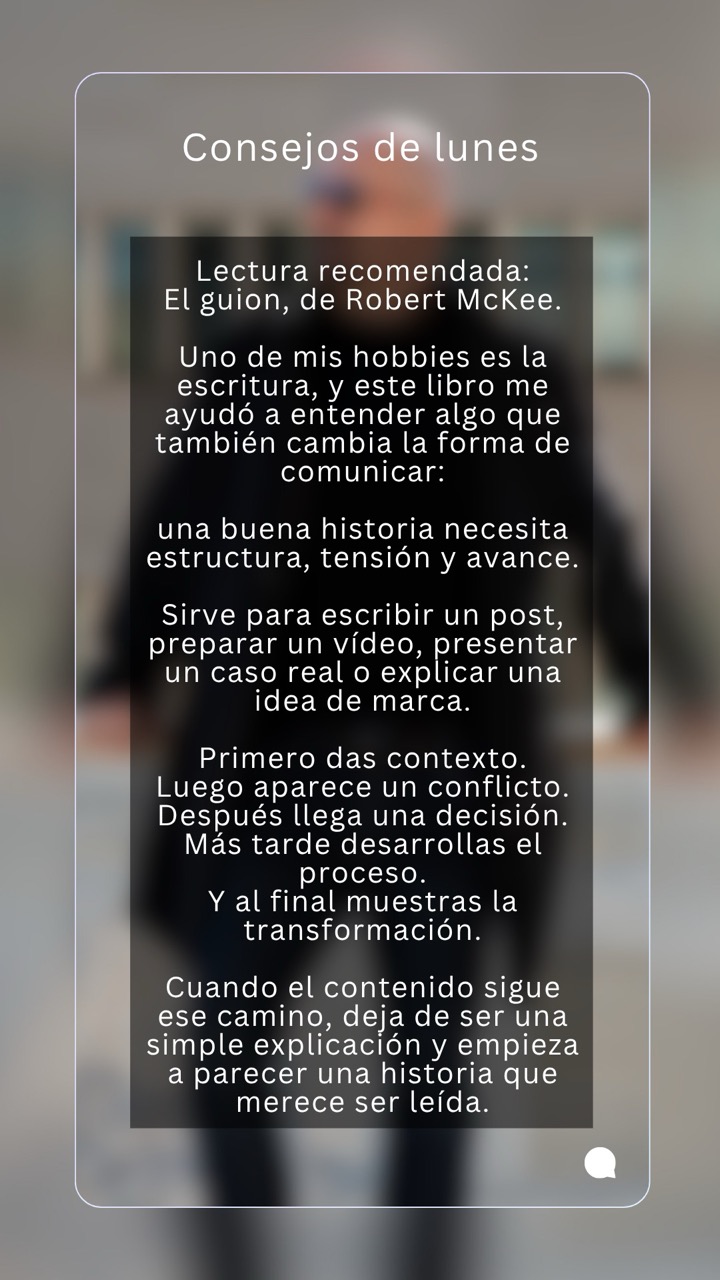
One of my hobbies is writing, and during May I shared a recommendation related precisely to this area: Story, by Robert McKee. It is a book focused on the construction of stories and screenplays, but many of its ideas can be transferred perfectly to marketing and corporate communication.
A good story needs structure, tension and progression. The reader or viewer needs to feel that something is happening and that each part leads naturally to the next. When we apply that logic to a company’s content, communication stops being limited to a succession of facts and begins to create a journey that is easier to follow and remember.
This can be used to write an article, prepare a video, present a case study, structure a commercial page, explain a project or develop a brand idea. The format changes, but the principle remains the same.
The structure I shared on Instagram can be summarised in five stages: context, conflict, decision, process and transformation. There is no need to turn every post into a film or artificially exaggerate what is happening. It is simply about organising information so that there is a clear and understandable progression.
First comes the context. We explain where we are, who has the problem or what the initial situation is. Then comes a conflict, understood as whatever is preventing the desired result from being achieved. From there, a decision is made, a process begins and, finally, we show what changes.
The difference compared with a purely descriptive explanation is important. Saying that a company offers a service provides information. Showing the situation the customer is facing, the problem that needs to be solved, the decisions that are made and the result that is achieved creates a story.
Stories also help organise information more effectively because users understand where the journey begins, what is at stake and where it is heading.
To develop the idea, I used a real estate agency as an example. The original commercial message could be very simple:
“We value your property so you can sell it at the best price.”
The message explains the service correctly, but we can turn that same proposition into much richer content by applying the previous structure. We do not change what the company does. We change the way we present it.
This is especially useful in marketing because many companies offer services that, when explained only through their features, can sound very similar to those of any competitor. Storytelling allows us to introduce context, professional judgement and progression, helping people better understand the value of the work.
The story can begin by showing a homeowner looking at their property and asking a very simple question: “How much is my home really worth?”
We already have a recognisable context. There is a person, a property and a decision that is about to begin. We do not need to explain the agency, its years of experience or all its services yet. First, we place the viewer in a situation they can understand immediately.
In a video, we could show the homeowner walking through the property or looking out of the window. In an article, we could describe the moment when someone begins to consider selling. In a commercial presentation, we could open directly with the question.
The context ensures that the content begins from the customer’s perspective rather than the company’s.
Then comes the conflict. The homeowner starts looking at property portals, comparing homes and doing the numbers. They have information, but they still need to interpret it correctly.
Here we can introduce two opposing risks. A price that is too high can reduce initial interest and slow down viewings. A price that is too low can speed up the sale, but it can also unnecessarily reduce the value obtained.
The communication begins to build tension because there is now something to solve. The question is no longer simply how much the property is worth, but how to establish a price that makes sense within the market.
This point is very important for any commercial content. The conflict explains why the service has value. A company exists because it solves something, improves something, makes a decision easier or helps achieve a result. Showing that intermediate point helps users understand the real purpose of the service.
Once the problem has been presented, the decision arrives. In the real estate example, the homeowner can continue trying to calculate everything independently or rely on a professional who understands the area, comparable transactions, the condition of the property and existing demand.
The agency now enters the story because we already understand why it is needed. The customer remains the protagonist and the company appears as part of the solution.
This approach usually works better than starting communication by talking only about the company itself. The service gains meaning within a specific situation.
It also makes it possible to present professional knowledge without turning the content into an endless list of qualities. Analysing the area, studying comparable properties, assessing the condition of the home and examining demand are actions. The user can visualise what happens during the work.
The process is one area that many brands could make better use of. Often, the problem is presented and then the communication jumps directly to the result. However, the process is precisely where a company can demonstrate experience, methodology and judgement.
In the case of the real estate agency, this process could include analysing similar transactions, reviewing real demand, studying the specific characteristics of the property, its location, condition, available competition and the strategy used to bring the property to market.
The same would happen in other sectors. A clinic can explain how it studies a case before recommending a treatment. An industrial company can show how it designs a solution. A consultancy can demonstrate how it analyses data before proposing a strategy. An SEO agency can explain how it studies a website, its competitors, user searches and domain authority before developing a search positioning strategy.
Showing the process adds depth. It also means that content no longer depends solely on statements such as “we are experts”, “we offer quality” or “we provide a personalised service”. Experience begins to become visible through what we actually do.
The final stage is the transformation. We return to the original situation and show what has changed.
At the beginning, there was a homeowner with a question: they did not know what their property was really worth or what price they should set. At the end, there is a reasoned valuation and a strategy for taking the property to market at a defensible price.
The transformation does not need to be spectacular. In corporate communication, it may mean moving from uncertainty to having clear criteria, from a technical problem to a solution, from a scattered strategy to an organised one, or from a website with little visibility to a project with a clear roadmap.
The important thing is that the user can identify the difference between the starting point and the final situation.
This way of structuring communication is not reserved for long articles. It can be condensed into a reel lasting just a few seconds, a sequence of stories, an advert, a carousel or even a short post.
In the real estate example, we could build five very simple scenes. First, the homeowner wonders how much their home is worth. Then they compare prices. Next comes the risk of pricing too high or too low. The fourth scene shows the professional working with data. The final one presents the property ready to go to market with a clear strategy.
In just a few seconds, we have told something with a beginning, development and outcome. The viewer understands the service without needing a long corporate explanation.
This also helps us manage attention more effectively. Each scene opens the door to the next and gives the viewer a reason to keep watching. Structure creates movement even when the subject itself is relatively technical.
The same logic can be applied to an article designed for search positioning. SEO requires us to respond correctly to search intent and organise information so that both search engines and users can understand it, but that does not prevent us from creating a reading experience that moves forward.
An article can begin by presenting a situation, then develop the problem, explain the available alternatives, show the process needed to solve it and finish by demonstrating the result the user can achieve.
This structure is particularly useful for content about services, real cases, comparisons, purchasing decisions and problems that require several stages of explanation.
SEO optimisation and narrative quality have different functions, but they can coexist perfectly. Content can use its keywords, headings, internal links and semantic structure correctly while also being written in a way that encourages people to keep reading.
In video, the structure becomes even more visible because each stage can be turned directly into a scene. There is no need to begin by presenting the company. We can start with a situation the audience recognises and allow the service to appear when the story needs it.
For example, a renovation company could begin by showing a kitchen that no longer meets a family’s needs. The conflict then appears: lack of space, poor layout or outdated installations. Next comes the decision to renovate, followed by the design and implementation process and, finally, the result.
An advisory firm could show a self-employed professional trying to organise documentation, introduce the difficulty of managing certain obligations, explain the working process and finish by showing an organised management system.
A technology company could begin with a manual task that takes too much time, demonstrate where inefficiency appears, introduce automation and finish by showing how the process changes.
The pattern is flexible because it does not depend on the sector. It depends on there being an initial situation, something that needs to change and a journey towards an improved situation. This connection between content, positioning and social media also forms part of a broader digital strategy, something I discuss in my article on how to integrate SEO and social media strategies.
Case studies are probably one of the areas where this structure makes the most sense. An isolated result can attract attention, but a result accompanied by the process explains the value of a company much more effectively.
We can begin by describing the state of the project when the collaboration started. Then we explain the main problem, the decisions that were made, the actions that were carried out and the progress that was achieved.
In this way, the case stops being just a final figure. It becomes a demonstration of methodology.
It also helps potential customers identify with similar situations. Their company may not have exactly the same problem, but they may recognise certain patterns: lack of visibility, difficulty attracting customers, an undefined strategy, a website that needs improvement or communication that does not explain the value of the business clearly enough.
Storytelling is not only about writing better. It also forces us to decide what is worth telling and from which perspective.
A company has many possible stories: how it works, how a product was created, how it solves a problem, how it develops a project, what it learns after a campaign, what questions customers ask or why it has made a particular decision.
When there is a clear editorial line, these stories gradually build a brand image. A business can convey experience by showing processes, closeness by sharing real situations, specialisation through specific cases or innovation by explaining how it incorporates new tools.
A brand is built gradually through all these pieces. A single post can perform well, but a coherent combination of content allows the audience to better understand who is behind the business, what they know how to do and how they think.
This second set of May tips also connects with the previous article on artificial intelligence. In that content, I explained the importance of building a sufficiently clear digital presence so that search engines, assistants and AI systems can understand what a brand does.
Structure and narrative add another layer. A website needs clear information and a good architecture, but it also needs content that explains experience, services, processes and cases in a useful way.
The more specific the information a company publishes about its activity, the more context exists around the brand. Real cases, detailed explanations and specialised content help build a more complete digital presence than a succession of generic corporate texts.
Other elements of the digital ecosystem also play a role. For businesses with a local presence, for example, a well-managed listing helps ensure that company information appears consistently in local searches. On my blog, I explain in more detail how to improve a Google Business Profile and its relationship with local visibility.
This is why communication, SEO, content, branding and GEO are increasingly converging at many points. Each discipline has its own techniques, but all of them work around the same reality: helping people and systems better understand who you are, what you do and why your work may be relevant.
I have always been interested in writing, and I believe that studying how stories are built contributes far more to marketing than it may initially seem. A book about screenwriting can teach us how to prepare better videos, articles, commercial presentations or case studies because it forces us to think about structure, tension, progression and transformation.
For me, the most important point is to stop treating content as an accumulation of information. We may have good data, experience and technical knowledge, but we also need to know how to organise them so that the person on the other side wants to continue.
Context, conflict, decision, process and transformation form a very simple structure, but one that is flexible enough to apply to practically any sector. There is no need to turn every piece of content into a major story. In many cases, it is enough to show clearly where the customer starts, what they need to solve, how we work and what changes afterwards.
This approach also fits with the direction I am following in this series of tips. Digital marketing, SEO, GEO, artificial intelligence, communication and branding are becoming increasingly connected. A strong strategy needs visibility, but it also needs content that clearly explains what we want to position.
And when we manage to combine both, content stops being a simple explanation and starts becoming a story worth reading, watching and remembering.
If you would like to learn more about my work, in addition to finding information about the agency’s services on this website, you can find me on Google Maps, where you can also find information about the agency and read client reviews.
My experience with local ChatGPT Work and Work Cloud: files, browsers, autonomy and context in SEO, website migrations and development… Leer más





Leave a Comment