Today I am starting a new series of blog posts connected to the content I share on Instagram every day. On my IG account, I publish stories with tips on marketing, digital marketing, GEO, local SEO, advertising and brand building, among other topics.
Here I bring them together in a single article so I can develop them in more depth, keep them organised by topic and provide the context that cannot fit into a single image.
If you want to see the series in its original format and follow the next tips as I publish them, you can follow me on Instagram.
Working on the same topic across Instagram, the blog, LinkedIn, stories, reels and long-form video also strengthens something important from an SEO and GEO perspective: brand consistency. When the same line of thought is explained clearly across different channels, search engines, maps, social networks and AI systems can better understand who you are, which topics you work on and the approach you take.
This first section brings together ideas that affect the overall structure of a brand. This includes the minimum presence a business needs in order to be understandable, the relationship between coherence and consistency, and the way an AI system or search engine interprets a complete digital ecosystem. Before talking about ads, creativity or frequency, it is worth making this clear. A brand with a weak foundation loses strength everywhere else.
Category: GEO and digital visibility tip
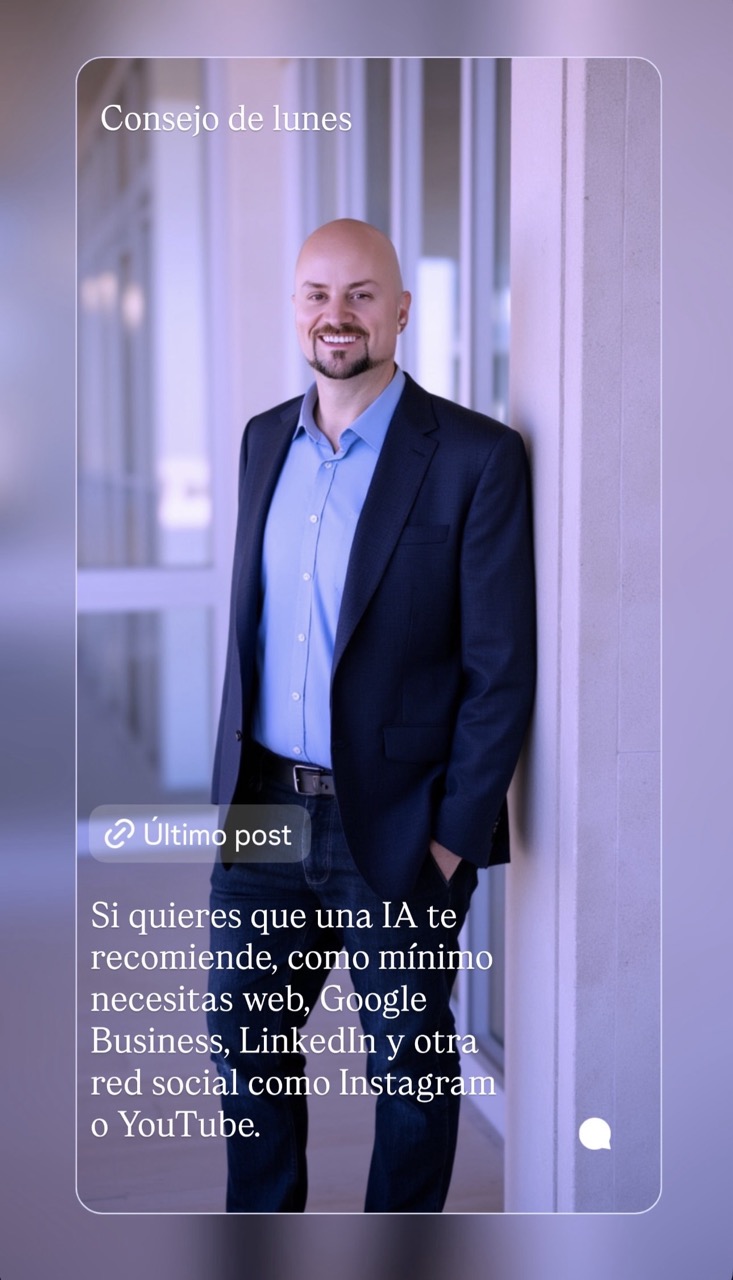
“If you want an AI system to recommend you, at the very least you need a website, Google Business, LinkedIn and another social network such as Instagram or YouTube.”
This tip summarises very well a reality that many brands still have not fully understood. An AI system does not recommend a business simply because it has a live website or a profile on a social network. For a system to understand a brand, locate it, associate it with an area of expertise and consider it a valid option, it needs cross-referenced signals. It needs to find a clear website, a strong local footprint, a professional profile that provides context and at least one channel where the brand demonstrates activity, expertise and real-world presence.
The website remains the foundation because it is where the structure of the business, its services, value proposition and commercial intent are defined. Google Business provides local validation, which is crucial when we talk about local SEO, geographic searches and recommendations based on proximity or territorial relevance. LinkedIn adds professional depth, especially for services, consulting, training or personal branding. Instagram or YouTube provide identity, visibility, educational value and proof of continuity. When all these elements fit together, the brand stops looking like an isolated profile and begins to behave like a properly structured entity.
From an SEO perspective, this improves brand recognition, authority and semantic consistency. From a GEO perspective, it improves contextual understanding. AI systems compare sources. If they find the same name, the same focus, the same services and the same location repeated consistently across different environments, it becomes easier for them to interpret that brand as legitimate, active and trustworthy. That is why this tip is not about opening profiles just for the sake of having them. It is about building a minimum digital presence that is credible and useful.
A dental clinic in Alicante may have a decent website, but if its Google Business Profile is poorly developed, there are hardly any reviews, no visible professionals on LinkedIn and no social channel where treatments or common questions are explained, the brand remains underdeveloped. By contrast, if the clinic clearly presents its services on the website, takes care of its local presence and publishes explanatory content regularly, its digital footprint gains depth and consistency.
A lawyer specialising in property purchases on the Costa Blanca needs more than a contact page. If their website explains processes, risks and documentation, LinkedIn reinforces their professional profile, Google Business validates location and reviews, and YouTube or Instagram demonstrate their ability to explain complex issues clearly, the brand becomes much easier to understand and recommend.
A marketing consultant in Alicante may talk about SEO, advertising and GEO on social media, but if the website does not explain those services properly or the local presence has not been developed, the overall perception remains incomplete. When all channels support each other, specialisation becomes much clearer both for users and for the systems that index and interpret that information.
Category: GEO and brand coherence tip
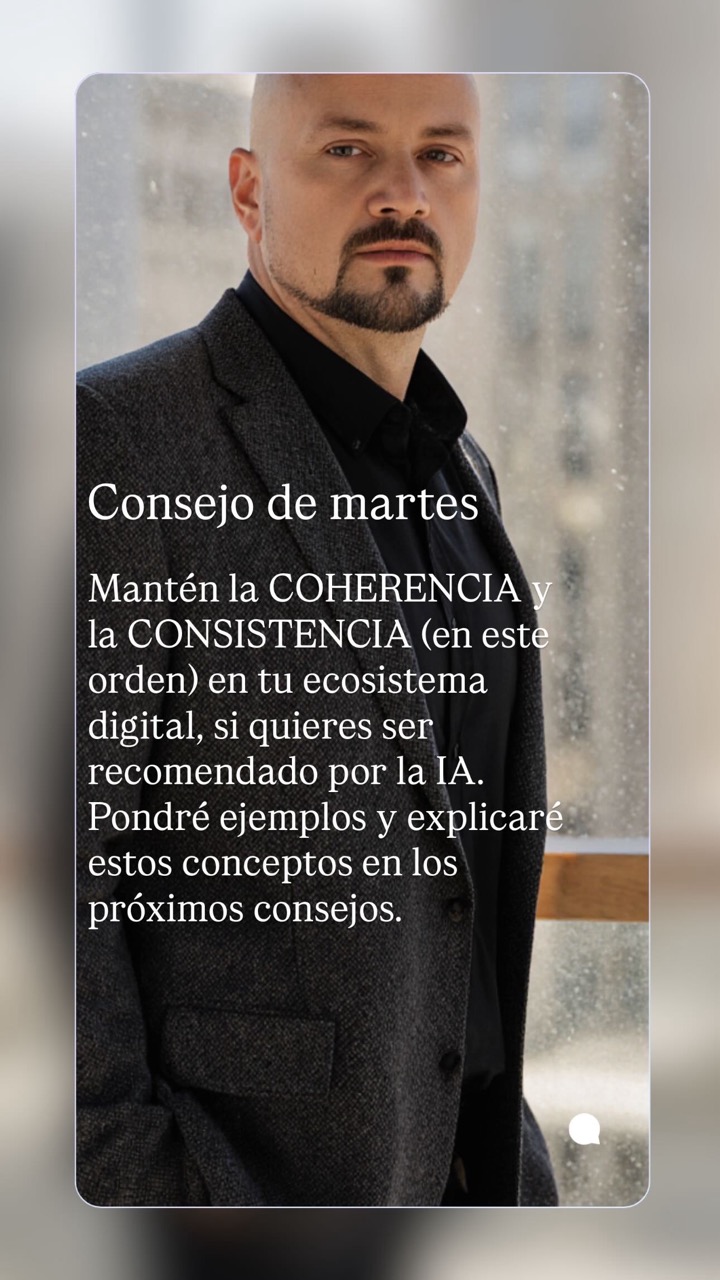
“Maintain COHERENCE and CONSISTENCY, in that order, across your digital ecosystem if you want to be recommended by AI. I will give examples and explain these concepts in upcoming tips.”
This tip is short, but it has a great deal of depth. Coherence means that what a brand says, does, promises and projects all fit together. Consistency means maintaining that line over time and across different channels. The order matters because repeatedly communicating something that is poorly focused does not strengthen a brand, it simply amplifies the confusion. First, there needs to be a clear identity. Then it makes sense to maintain it consistently.
An AI system, just like a user, detects patterns. If the website claims one specialisation while social media seems to go in a completely different direction, if the tone changes radically from one channel to another, or if the business presents itself one way on Google Business and another way on LinkedIn, the overall interpretation becomes weaker. By contrast, when the brand maintains the same core positioning while adapting the format and language to each channel, the interpretation becomes much stronger. That is where coherence and consistency work together.
This has direct importance for both SEO and GEO. A strong brand entity is not built only through frequent publishing. It is built through well-aligned signals. The name, proposition, specialisation, geography and communication style all need to support one another. Consistency creates accumulation. Coherence gives that accumulation meaning. Without meaning, accumulation has little value.
An agency says on its website that it specialises in lead generation for SMEs, but on Instagram it only publishes generic motivational quotes and on LinkedIn it talks about entrepreneurship without a clear focus. There is activity, but no recognisable line. An AI system does not get a clear picture of what that brand actually does.
A firm that maintains the same proposition for months across its website, local listing, articles and social profiles gradually builds a footprint that is much easier to interpret. It does not look like an improvised brand, but rather one with a clear and sustained point of view.
A personal brand that talks about SEO one day, finance the next, psychology another day and productivity after that may generate noise, but not positioning. Once it focuses its communication around a recognisable central theme, consistency begins to add value because it is built on prior coherence.
The second section focuses on how a brand communicates. This includes clarity of message, the value of human work in content and the importance of showing a recognisable identity. These are digital marketing tips, but they are also branding principles. A company does not only compete to appear. It competes to be understood, remembered and perceived as something real.
Category: communication and digital marketing tip
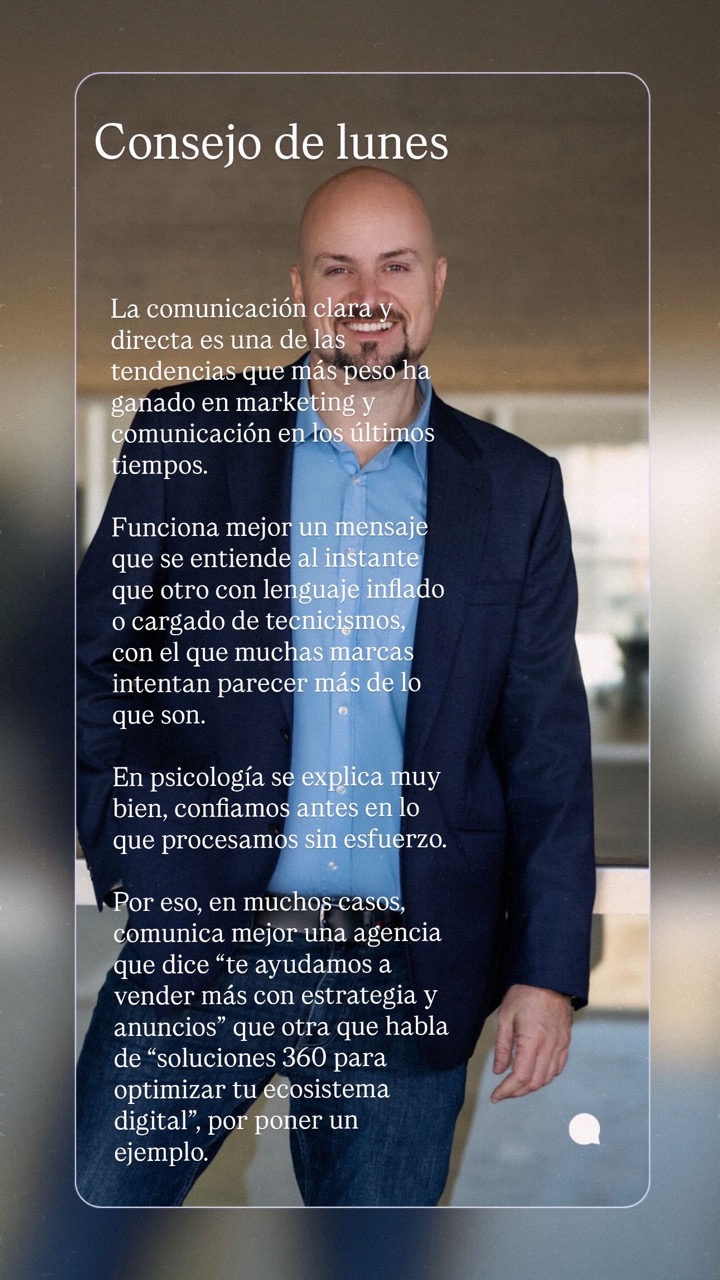
“Clear and direct communication is one of the trends that has gained the most importance in marketing and communication in recent years.
A message that is understood immediately works better than one filled with inflated language or technical jargon, which many brands use in an attempt to appear more impressive than they are.
Psychology explains this very well: we tend to trust what we can process easily.
That is why, in many cases, an agency that says ‘we help you sell more through strategy and advertising’ communicates better than one that talks about ‘360-degree solutions to optimise your digital ecosystem’, for example.”
This tip addresses one of the most common mistakes in brand communication. Many companies believe that sounding complex gives them prestige. What often happens is the opposite. A message full of excessive jargon, grandiose expressions and empty formulas creates distance. The reader does not feel impressed, they feel effort. And when a message requires too much work to understand, it loses a significant part of its effectiveness.
Clarity does not lower the level. It defines it better. A professional can explain something complex in simple terms without losing rigour. In fact, that is often a sign of genuine mastery of the subject. In marketing and communication, clarity accelerates understanding, strengthens connection and reduces friction in decision-making. It also adds considerable value in SEO because it allows us to respond more precisely to search intent and makes it easier for an AI system to understand what the brand does and how it expresses it.
When a brand says exactly what it does and who it does it for, its credibility increases. When it hides behind decorative expressions, it becomes vague. People do not remember complicated language better. They remember what they understand quickly and find useful. That is the strength of this tip.
An agency can say “we develop high-impact integrated solutions for complex digital ecosystems”. It sounds impressive, but says very little. If it says “we help you sell more through strategy, advertising and measurement”, the message becomes clearer and commercially stronger.
An aesthetic clinic can talk about “advanced dermocosmetic protocols”, but the customer is more likely to connect with “treatments to improve firmness, texture and brightness with a personalised assessment”. The second version is easier to understand and communicates greater usefulness.
A law firm that explains “we help you buy a property on the Costa Blanca with legal certainty and no unpleasant surprises” connects much faster than one that fills the page with technical language without translating it into the real benefit for the customer.
Category: content and authenticity tip
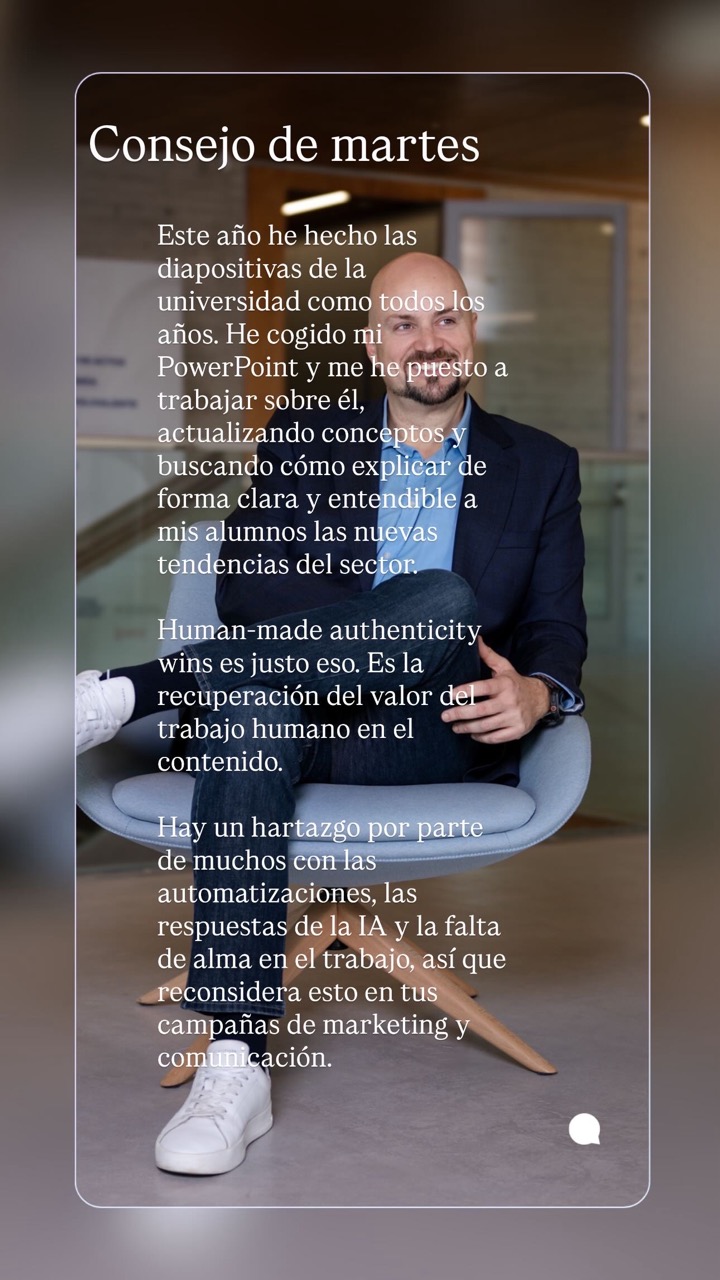
“This year I prepared my university slides as I do every year. I took my PowerPoint and started working on it, updating concepts and looking for ways to explain the latest industry trends clearly and understandably to my students.
Human-made authenticity wins is exactly that. It is the return of the value of human work in content.
Many people are becoming tired of automation, AI-generated responses and work that lacks personality, so reconsider this in your marketing and communication campaigns.”
This tip points to a real sense of fatigue in the market. There is a great deal of content that is formally correct but empty underneath. The problem is not using tools, but losing the human hand in the process. When content feels mass-produced, with no experience behind it, no original examples and no educational or strategic intention, its impact becomes flatter. It may fulfil a mechanical function, but it becomes much harder for it to connect, persuade or remain memorable.
Human work adds nuance, mental structure, judgement and context. It also contributes something that is very difficult to imitate: a personal way of explaining things. You can notice it in an article, a presentation, a video or a short social media post. When someone reviews, corrects, adapts and develops an idea so that another person can genuinely understand it, the content gains depth. That depth has significant value today because users are becoming increasingly able to recognise the difference between something carefully developed and something simply generated.
This also matters for SEO and GEO. Content with voice, judgement and experience often differentiates a brand more effectively and tends to perform better for searches that require explanation, comparison or interpretation. Having text is not enough. You need content with personality, perspective and real usefulness.
A lecturer who reworks their materials every year to update concepts and improve the way they explain them is creating genuinely human content. They are not simply repeating a template. They are thinking about how to teach more effectively.
A company that shares real customer cases with details, problems and solutions communicates much more authenticity than another that simply publishes generic statements with no context. The reader can see that there is real experience behind the content.
A consultant who writes an article using their own examples, mistakes they have identified and lessons they have learned may sound less artificially perfect than mass-generated content, but it will usually be far more credible and memorable.
The third section focuses on the most dynamic side of digital marketing. This includes speed of reaction, the strength of creativity compared with targeting and frequency management to avoid saturation. These tips are very useful for social media, advertising campaigns and branding, but they also help explain how user attention moves today.
Category: social media marketing tip
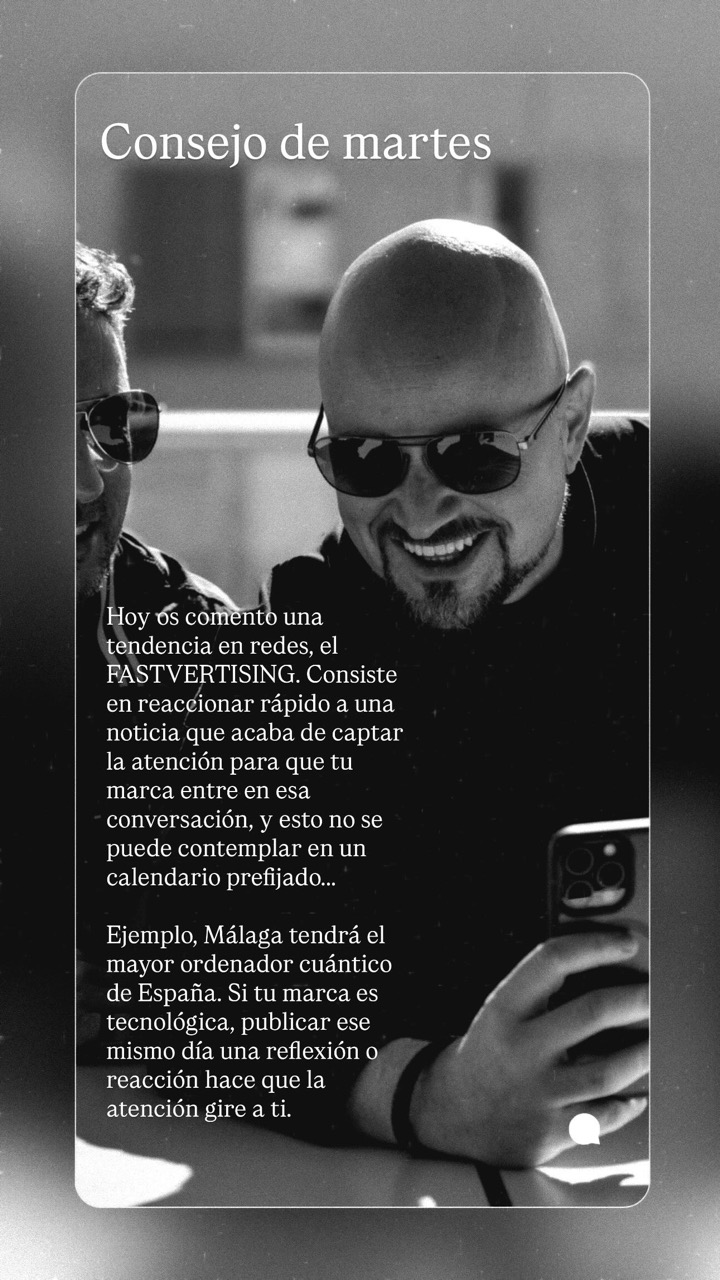
“Today I want to talk about a social media trend: FASTVERTISING. It consists of reacting quickly to a news story that has just captured public attention so that your brand can enter that conversation, and this is something that cannot be fully planned in a fixed calendar…
For example, Málaga is going to have the largest quantum computer in Spain. If your brand is in the technology sector, publishing a reflection or reaction that same day can help direct some of that attention towards you.”
Fastvertising works because collective attention moves in waves. There are moments when a news story concentrates conversation and suddenly brings a topic to the forefront. Brands that react quickly and appropriately can enter that conversation much more effectively than with a scheduled post published outside the relevant context. The advantage comes from arriving exactly when interest is high.
The key is the natural connection between the news and the brand. It is about contributing when there is genuinely something relevant to say. A technology brand can comment on technological infrastructure. A law firm can react to a regulatory change. A tourism company can comment on an important development affecting its sector or region. In those cases, the content gains traction because it responds to the moment.
From an SEO and GEO perspective, this type of content can also be useful because it generates topicality, mentions and thematic presence around active searches. It complements more evergreen content with agility and the ability to react quickly.
A software company can publish an immediate reflection when a major investment in artificial intelligence, cybersecurity or advanced computing is announced. If it does so on the same day and adds a useful perspective, it gains relevance.
A tax adviser can react quickly to a tax update by explaining what actually changes for self-employed professionals and companies. This allows them to enter the conversation with authority.
A brand connected to tourism on the Costa Blanca can use a news story about air connectivity, infrastructure or market movement to provide a well-focused local interpretation and gain visibility on social media.
Category: digital marketing and paid media tip
“Targeting-First versus Creative over Targeting.
Creative over targeting is a trend that shows that today advertising depends less on manual targeting and more on the strength of the creative.
The algorithm finds the audience, but the creative is what attracts them.
In short, spend more time creating something good than trying to segment everything down to the smallest detail.”
This tip gets to the heart of how many campaigns are performing today. For years, a significant part of advertising work focused on fine-tuning audiences, interests and layers of segmentation. That approach made sense in a certain context, but current algorithms already handle much of the distribution. What remains difficult is capturing genuine attention. This is where creativity becomes especially important.
When a creative performs poorly, even extremely precise targeting cannot save it for very long. If the advert does not engage, generate emotion, create curiosity or clearly communicate the benefit, performance suffers. By contrast, when the creative has a strong opening, a good angle and communicates the proposition clearly, the system quickly learns who should see it. That is why many campaigns today improve more through better creatives than through obsessive micro-adjustments to audiences.
Creativity here does not simply mean attractive design. It includes the opening angle, first sentence, demonstration, clarity, proof, rhythm and the way the offer is presented. The creative is what stops the scroll and generates a response. The algorithm observes that response and does the rest.
A restaurant can target very precisely by location and interests, but if the advert is flat it may produce little response. A creative showing an attractive scene, a clear proposition and the atmosphere effectively has a much better chance of performing.
An aesthetic centre can spend hours refining very specific audiences, but if the advert does not explain the treatment well or communicate trust, performance will stall. A clear and well-focused creative often makes a much bigger difference.
A B2B company may target very specific job roles, but if the message is full of empty jargon, interest falls. If the advert presents a real problem and explains a concrete solution, the creative gains traction even when the targeting is less obsessive.
Category: digital advertising and frequency tip
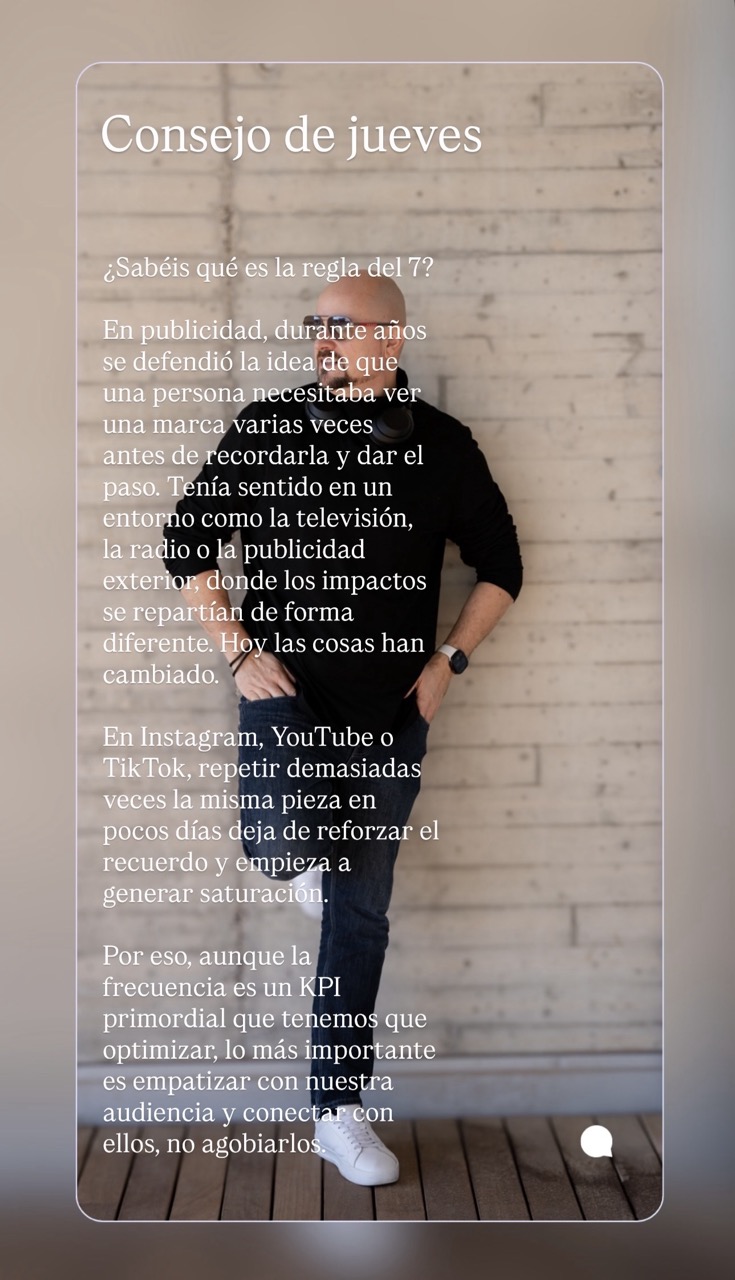
“Do you know what the rule of 7 is?
For years, advertising theory argued that a person needed to see a brand several times before remembering it and taking action. That made sense in an environment such as television, radio or outdoor advertising, where impressions were distributed differently. Today things have changed.
On Instagram, YouTube or TikTok, showing the same creative too many times in just a few days stops reinforcing memory and starts creating saturation.
That is why, although frequency is a key KPI that we need to optimise, the most important thing is to empathise with our audience and connect with them rather than overwhelm them.”
This tip corrects an idea that was used almost automatically for a long time. Frequency remains an important metric, but the context has changed completely. On television, radio or outdoor advertising, impressions were distributed in a different way. On social networks and video platforms, the same person can see the same creative too many times in a very short period. At that point, repetition stops reinforcing memory and begins to create fatigue or rejection.
The issue is not eliminating frequency, but managing it intelligently. A brand needs to appear several times in order to build recognition, but repeatedly showing a single creative until it is exhausted makes little sense. Users should not feel pursued. They should feel a useful and relevant presence. This is why sequences, message variations and creative refreshes often make more sense than pushing the same piece until it burns out.
In campaigns on Instagram, YouTube or TikTok, this is crucial. Reasonable frequency combined with creative diversity usually works better than high pressure with a single ad repeated to exhaustion. The brand builds memory without damaging perception.
An e-commerce business that shows the same remarketing advert for ten consecutive days can create rejection even among interested users. If it distributes the message across several pieces with different approaches, the experience improves considerably.
A training provider promoting a master’s degree on Instagram or LinkedIn can exhaust an advert if it always uses the same creative. If it alternates testimonials, career opportunities and programme explanations, it maintains visibility without becoming tiring.
A local brand running awareness campaigns on YouTube can lose effectiveness if it uses a single video too frequently. By working with several pieces within the same creative line, it protects both recall and brand perception.
This final section closes the series with two closely related ideas. The first reinforces the value of content with personality and judgement. The second brings that value into the visible identity of the brand. These tips affect marketing, reputation, positioning and the ability to connect in a market filled with similar messages.
Category: branding and differentiation tip
“Returning to what is real, or what is known as ‘human-made authenticity wins’, is a trend. People are becoming tired of so much AI-generated content and brands with no identity, so do not be afraid to show yourself as you are. What you think are flaws may be exactly what helps you connect with your customer.”
A brand without identity can have visibility, but it is much harder for it to build a real connection. Users remember what they perceive as recognisable. Generic perfection rarely leaves a lasting impression. Well-managed individuality does. That is why this tip has so much potential. It does not encourage improvisation or a lack of professionalism. It encourages brands to preserve their own characteristics and a genuine way of expressing themselves.
This is particularly visible on social media. The profiles that connect best are not always the most polished, but often the ones with the clearest personality. The same applies to articles, videos and posts. Identity can be found in the way something is explained, the types of examples used, the tone, the judgement or the angle from which a topic is approached. It should be developed deliberately, but it should not be hidden.
From an SEO and GEO perspective, identity helps build a more memorable brand entity. It encourages branded searches, mentions, recommendations and a more stable perception. A recognisable brand becomes less interchangeable. In a market full of similar messages, that is extremely valuable.
A professional who communicates in their real voice instead of copying a standard corporate tone usually builds a more direct relationship with their audience and stronger brand recall.
A local business that naturally shows who is behind the service and how they work generates a very different kind of trust compared with a brand that looks flawless but remains completely anonymous.
A company that embraces its own approach and communicates it confidently attracts the right customer more effectively than one that tries to appeal to everyone with a completely neutral and personality-free message.
These tips all have something in common. They are based on a very simple idea. Marketing works better when it is built on clarity, coherence and a real identity. A brand does not need to appear to be more than it is. It needs to explain itself well, maintain its message over time and build a digital presence that makes sense for its customers and for the environment in which it competes.
We are entering a stage in which excessive automation, inflated language and soulless content are beginning to create fatigue. As a result, brands that know how to communicate with judgement, understand how to connect without overwhelming people and build their digital ecosystem through a more human and solid approach are gaining importance again. That is where a company stops looking like just another option and begins to occupy a recognisable place in the audience’s mind.
Ultimately, these marketing tips, digital marketing tips and GEO tips all point in the same direction. Build a solid digital foundation, communicate clearly, take care of creativity, respect the audience’s attention and show a distinctive identity. When executed well, this combination makes a brand more credible, more visible and considerably harder to replace.
I encourage you to follow this series closely if you want to learn more about marketing. I will continue sharing tips on my social media channels in text and video formats, along with updates on Google Business.
My experience with local ChatGPT Work and Work Cloud: files, browsers, autonomy and context in SEO, website migrations and development… Leer más



Leave a Comment